







By Sally Furrer
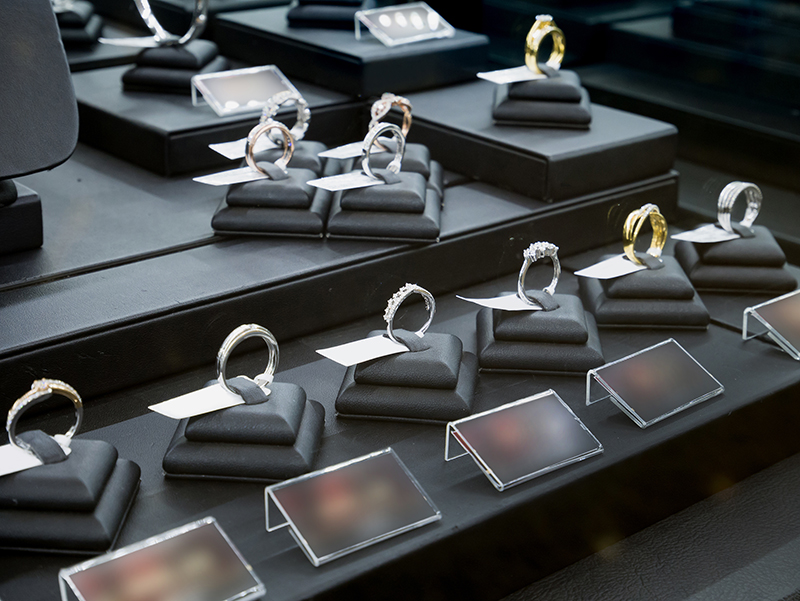
In case signage can be a very helpful tool to communicate with your customers while they are browsing, enhance your product and most importantly, tell a story. Always assess your signage to make sure that it is consistent with your store brand and image.
A few important notes to keep in mind: Too much pricing or signage combined with multiple slot trays create a “mall store” look. Less is more. Some pricing is recommended so your customer has a sense of affordability, but use sparingly, and use groupings of “starting at $495”, for instance.
If you have unique, interesting or proprietary product you will definitely want to highlight them with signage.
Here are a few more considerations to take into account for signage.
Signage Basics
- Signage could be a designer name, a collection name, a collection tag line, visuals and images, store features and benefits, or even pricing. Every showcase should have some kind of signage.
- The primary sign should be at the front and in the centre of the case. Other signage can be on or beside your platforms.
- Changing out your signage seasonally is another way of keeping your showcases fresh looking.
- Keep signs free of fingerprints or any evidence of wear and tear.
- Never use hand-made or hand written signs. Have a printer create them for you.
- Signage should always have a holder which matches your displays. An exception would be some pricing modules.
Tell a Story
- Each showcase, or platform within a showcase, should be a “storyboard” in itself.
- Jewellery should not be displayed based on their components: for example, all 1 pc. Semis grouped together, and all 2 pc. Semis grouped together. They should be grouped by look and feel (design), because that is how a customer shops.
- Group your product into collections that tell a story. For instance, you could display a collection of amethyst, citrine and smoky quartz jewellery and sign it “Brazilian Beat”. Add some gemstone rough, and you have a story that is relevant and interesting to your clients.
- A tagline gives the client more information about the grouping or Collection–ex: The Eclat Diamond Collection—“Superior Brilliance Your Eyes Can See”.
- Add a framed bio with image for each of your designers. Sales associates need to make a designer come alive, so these are a great prompt.
- Add framed visuals to each case—for example: A romantic sepia photo of a couple embracing in your bridal case. Or an image of a celebrity wearing large hoops with your hoop earring collection.
Positioning the Stories
- Always work from the centre out. The merchandise displayed should “flow out” from the centre.
- Assume the customer is standing in front of the case, so arrange the merchandise to face the customer. If a lighting baffle blocks the view, make sure the platforms and elements are toward the back of the case.
- Try to balance each story so that it’s not weighted on one side or another.
- Space items so that the eye is forced to focus on one item – or a group of items before moving onto the next group.
- Curves lead the eye more effectively than hard lines, so try to incorporate curved shapes into your story.

Author: Canadian Jeweller Magazine Staff
Canadian Jeweller Magazine Staff is the shared byline for reporting filed by the magazine's editorial desk. Founded in 1879, Canadian Jeweller is the longest running jewellery business publication in Canada, covering market reporting, retail strategy, watches, diamonds, coloured gemstones and the commerce of the Canadian jewellery trade. Work published under this byline is edited and verified by the Canadian Jeweller editorial team in Toronto.


