
Ask the Robot About Your Store: AI Search for Jewellery Stores Is Still Unclaimed
ChatGPT named just 1.2 per cent of store locations in a 2026 study. A five minute test and four free fixes help a jeweller become one of the stores AI assistants recommend this December.

AI search for jewellery stores draws on what the web already says about each store: its own website, its Google Business Profile, Yelp and Facebook. The assistants name very few stores, so the jeweller who makes those sources clear before December has a real chance to be the answer.
Picture a shopper in a mall parking lot on December 12. She asks her phone for a store nearby that can engrave a pendant by Friday. The assistant replies with two or three names and a short reason for each one.
That short list is the opportunity. In SOCi’s 2026 Local Visibility Index, ChatGPT recommended just 1.2 per cent of the 350,000 store locations it analysed. By comparison, 35.9 per cent of those locations appeared in Google’s local three pack. So the AI answer is far more selective, and it is still open to the stores that prepare for it.
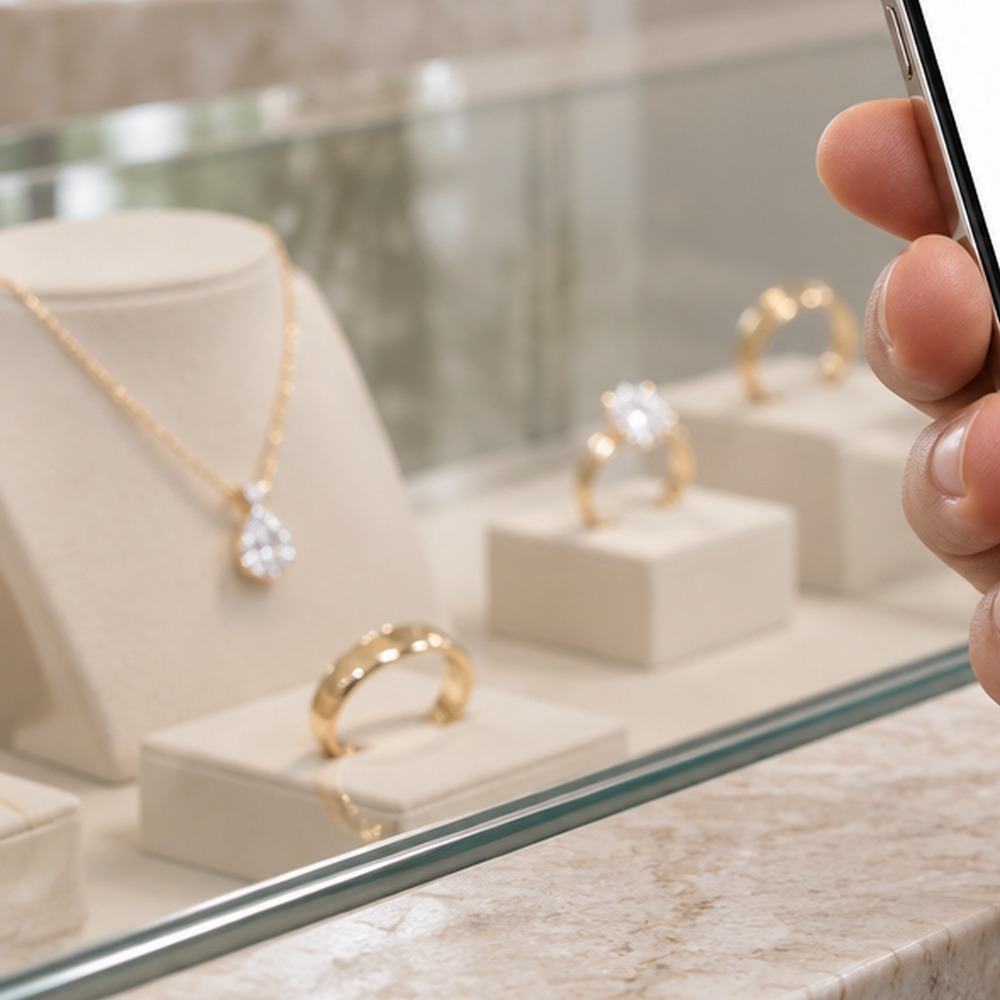
Why is AI search for jewellery stores worth attention this Christmas?
Canadian shoppers already use these tools. Salesforce found that 39 per cent of Canadian shoppers used an AI tool for shopping in the past 12 months. About one in nine now starts the shopping journey there, up from single digits a year earlier.
The holiday numbers point the same way. Deloitte’s 2026 Holiday Retail Outlook found that 39 per cent of Canadian consumers plan to use AI for holiday shopping, up from 25 per cent in 2025. Among shoppers aged 18 to 34, half would ask AI for gift ideas.
Most of that money still lands in a physical store. Deloitte expects 55 per cent of planned holiday spending to happen in store, so an AI recommendation often ends with a customer at the counter. In September, Canadian Jeweller also reported on AI shopping agents that complete purchases for the shopper.
| Measure | Figure | Source |
|---|---|---|
| Canadian shoppers who used an AI tool for shopping in the past year | 39 per cent | Salesforce, September 2026 |
| Canadian shoppers who now start shopping with AI | About 11 to 12 per cent | Salesforce, September 2026 |
| Canadians planning to use AI for holiday shopping | 39 per cent, up from 25 | Deloitte Canada, 2026 |
| Holiday spending expected in store | 55 per cent | Deloitte Canada, 2026 |
| Canadians planning to use AI to find deals this season | 40 per cent | Accenture, 2026 |
| Store locations ChatGPT recommended | 1.2 per cent | SOCi, January 2026 |
How can a jeweller test what ChatGPT says about the store?
The test takes about five minutes. First, open a private browser window on a phone, so the answers are not shaped by your own history. Then ask ChatGPT, Gemini and Google’s AI Mode the same three things.
- “Best jeweller in” followed by your city.
- “Where to buy an engagement ring in” followed by your city.
- “Watch battery replacement near” followed by your neighbourhood.
Screenshot every answer. Then note three things for each one: whether the store appears, whether the description is accurate, and which competitors the assistant names instead. ChatGPT and AI Mode also list the pages they drew from, and those links show which sources need attention first.
Where does AI get its information about a local jeweller?
BrightLocal published the most detailed answer in August 2026. Its team ran 60,970 checks across 1,355 business locations in the United States, the United Kingdom and Australia. Then it recorded almost two million citations from Google AI Overviews, Google AI Mode and ChatGPT.
Google Business Profile was the largest single source, at about 28.6 per cent of all citations. Google’s own AI tools used it for virtually every location. ChatGPT leaned hardest on Yelp, which appeared in 80 per cent of its answers. The assistants cited Facebook for about 93 per cent of businesses, and the Better Business Bureau for about 29 per cent.
Business websites still matter most by count. Individual business sites made up about 93 per cent of the domains the assistants cited. SOCi adds one more signal: the locations ChatGPT recommended averaged 4.3 stars.
Canadian data on AI citation sources is not available. The BrightLocal study did not cover Canada, so its figures serve as the best benchmark for now.
What should a jeweller fix first?
Start with the sources the assistants read most. Each fix below costs nothing but staff time.
Google Business Profile
Confirm the primary category is jewellery store. Then add secondary categories for jewellery repair, watch repair, appraisals and custom design where they apply. List each service with a short description, and post holiday hours before December 1. Add fresh photos of the showcases, because they give the assistant something specific to describe.
Yelp and Facebook
Claim the Yelp listing, since ChatGPT cites Yelp so often. Then check that the name, address, phone number and hours match the Google profile exactly. Do the same on the Facebook page. When these sources disagree, the assistant has less reason to trust any of them.
The store website
Write the city, the services and the brands carried in plain sentences on the homepage. Then give each service its own page: ring sizing, repairs, watch batteries, appraisals, custom design and engagement rings. Answer the questions staff hear every day, such as turnaround time, starting price and whether the work can be done while the customer waits.
Ask the web developer to add local business schema markup with the address, hours and coordinates. This structured data tells the assistant exactly where the store is and when it is open.
A strong service page answers the shopper’s question in its first two lines. Take a page for watch batteries. It opens with the service and the city in one plain sentence, then states that most batteries are replaced while the customer waits. Next come the brands the bench services, the water resistance test offered after a battery change, and the starting price. A short paragraph on what happens when a watch needs more than a battery closes the page.
That page gives an assistant four facts it can repeat with confidence: what, where, how fast and how much. A vague page that says “we offer a full range of services” gives it nothing. So the stores with specific pages are the ones the assistant can recommend for specific requests.
Bilingual markets
Stores in Quebec, Ottawa, Moncton and other bilingual markets have an extra advantage to claim. Shoppers ask assistants in the language they speak at home. So a store that writes its key service lines in both English and French has text to match either request. Add a French description to the Google Business Profile and French versions of the main service pages.
Reviews
Ask satisfied customers for reviews through December, and reply to each one. A steady flow of recent reviews also gives the assistant fresh language to repeat about the store.
What is a realistic holiday timeline for AI search for jewellery stores?
Six weeks is enough time to cover the fixes above, as long as the work starts now. The schedule below fits around a busy floor.
| Week | Task | Who |
|---|---|---|
| November 10 to 16 | Run the five minute test and save the screenshots | Owner or manager |
| November 17 to 23 | Update Google Business Profile categories, services and photos | Owner or manager |
| November 24 to 30 | Claim Yelp, match Facebook details, post holiday hours everywhere | Any staff member |
| December 1 to 14 | Add service pages and schema markup to the website | Web developer |
| Through December | Ask for reviews after every sale and repair pickup | Sales staff |
| Early January | Repeat the test and compare against November | Owner or manager |
Most of this list takes an hour or two at a time. Also, every task on it keeps paying off after the holidays, because bridal and repair questions come in all year.
The same work also helps ordinary Google search. A complete profile, consistent listings and clear service pages are long established local search basics. So none of the effort is wasted, even if AI tools change their sources next year.
How should a jeweller measure progress in AI search?
Repeat the same three questions every month, on the same private browser setup. Keep the screenshots in one folder, so changes are easy to compare. Also add “an AI assistant” to the list of answers staff record when customers say how they found the store.
The first month a store appears in an answer is worth sharing with the whole team. After that, the work is mostly upkeep: current hours, new photos and replies to every review.
Frequently asked questions
Does ChatGPT use Google Business Profile?
Google’s own AI tools used Google Business Profile for virtually every location in BrightLocal’s 2026 study. ChatGPT drew most heavily on Yelp, which appeared in 80 per cent of its answers, so jewellers should keep both listings current.
Is there Canadian data on AI search for local stores?
Canadian data exists on shopper adoption: Salesforce found 39 per cent of Canadian shoppers used AI for shopping in the past year. Canadian data on which sources AI tools cite is not available yet.
Which AI assistants should a jewellery store test?
Test ChatGPT, Gemini and Google’s AI Mode, the assistants built into the apps most shoppers already carry. Perplexity is worth a monthly check as well.
What is the first fix for AI search for jewellery stores?
Start with the Google Business Profile. Confirm the categories, list every service and post holiday hours before December 1.
How long do changes take to appear in AI answers?
No assistant publishes a timeline, and results vary by tool and by city. Repeating the same test every month is the most reliable way to see when a store starts to appear.
Sources: SOCi Local Visibility Index 2026, Salesforce via Retail Insider, Deloitte Canada Holiday Retail Outlook 2026, Accenture via Retail Insider, BrightLocal AI directory sources study.

Author: Olivier Fel.
Olivier Felicio is the founder and publisher of Canadian Jeweller Magazine, Canada's jewellery business publication since 1879. He writes on retail strategy, market data, trade policy and the commercial side of the Canadian jewellery and watch trade, and hosts Time and Shine, Canada's jewellery buying event. Contact: olivier@canadianjeweller.com.