






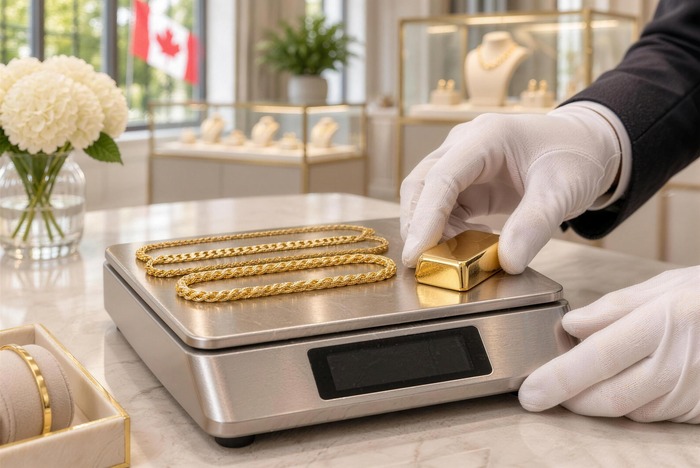
The gold price outlook now turns on one number: US$4,000 an ounce. Gold closed at US$4,074.90 on November 6, and HSBC expects central banks to buy harder if it falls toward that level. For Canadian jewellers, the price matters less than how it reaches the showcase.
Market data as of November 8, 2026. Analysis by Canadian Jeweller Magazine, Canada’s jewellery business publication since 1879.
Gold price outlook: key takeaways for Canadian jewellers
- Gold closed at US$4,074.90 an ounce on November 6, 2026, about 27 per cent below its January 28 record of US$5,589.38.
- HSBC expects central bank buying to strengthen near US$4,000, and central banks bought 321 tonnes in the third quarter.
- In Canadian dollars, every US$100 move in gold changes 14 karat alloy by about C$2.64 a gram.
- Recycled gold rose 10 per cent in Canada in the third quarter while it fell 8 per cent worldwide, according to the World Gold Council.
- Canada allows 9 karat gold marked .375, while the United States does not sell pieces under 10 karat as karat gold.
- The Bank of Canada raised its policy rate to 2.5 per cent on October 28, and its next decision is December 9.
Most coverage this weekend repeated a wire story from New Delhi. Analysts there told the Press Trust of India that bullion would stay under pressure while markets track the US Iran war, five inflation reports and a week of Federal Reserve speeches. That forecast is reasonable. It is also the least useful part of the story for anyone who sells gold by the gram.
Canadian Jeweller has reported on gold since 1879. We were 101 years old when gold first touched US$850 in 1980, and 132 when it peaked in 2011. The lesson from both cycles is practical. The stores that came through well understood how a world price becomes a price per gram on their own tags.
What is the gold price outlook below US$4,100?
Start with the floor, because the trade watches it closely. On October 1, HSBC trimmed its forecast to an average of US$4,490 for 2026 and US$4,825 for 2027. In the same note, it said central bank buying should strengthen if gold falls toward or below US$4,000.
Central banks are already acting. The World Gold Council counted 321 tonnes of official buying in the third quarter, up 42 per cent from a year earlier. So the metal sits about US$75 above the line where its largest buyers tend to step in.
The ceiling is far less clear. In June, J.P. Morgan lowered its targets but still called for US$6,300 by late 2027. Its main risk case is a Fed hiking cycle that drains Western gold funds. With Kevin Warsh’s Fed holding at 3.75 to 4 per cent, that risk is real, but it has not arrived.
In short, the professional gold price outlook for 2027 runs from the high US$4,000s to above US$6,000. A spread that wide tells you one thing. Nobody should stake the holiday buy on a single forecast.
How much does every US$100 move cost a Canadian jeweller?
Canadian stores live with two prices at once. Gold trades in US dollars, but you sell in Canadian dollars. On November 8, spot gold stood at C$5,743.80 an ounce, according to GoldBroker. That implies a rate of about C$1.41 per US dollar.
At that rate, every US$100 move in gold changes pure metal by about C$4.54 a gram. A one cent swing in the loonie moves it by about C$1.31 a gram. Many chain and findings suppliers bill metal at the market price on the invoice date, plus labour by the gram. That makes this card worth taping beside the register.
| Karat (Canadian decimal mark) | Gold value per gram of alloy, Nov 8 | Change per US$100 move in gold |
|---|---|---|
| 9K (.375) | C$69.25 | C$1.70 |
| 10K (.416) | C$76.82 | C$1.89 |
| 14K (.583) | C$107.66 | C$2.64 |
| 18K (.750) | C$138.50 | C$3.40 |
| 24K (pure) | C$184.67 | C$4.54 |
Now apply it to a 10 gram chain in 14 karat. At the January 28 record of US$5,589.38, its gold was worth about C$1,422. Today it is worth about C$1,077, which is roughly C$345 less. Each further US$100 drop takes another C$26 off the metal in that chain.
Accounting adds a twist. Canadian rules do not allow last in, first out inventory, so stock bought near the peak stays on your books at January cost. Price new sales to replacement cost instead, or your margin report will mislead you for months.
Why are Canadians selling more old gold than the rest of the world?
This is the Canadian signal most coverage missed. Worldwide, recycled gold fell 8 per cent in the third quarter to 314.5 tonnes, the lowest since late 2023, the World Gold Council reports. Canada went the other way, with recycling up 10 per cent from a year earlier.
That means metal is walking into Canadian stores. Every chain that comes across the counter is a sales conversation as much as a scrap purchase. In China, a 7 per cent sales tax on gold jewellery has pushed shoppers to trade old pieces toward new ones. The same trade in model works here, without the tax.
Meanwhile, the buying side remains healthy. Statistics Canada shows sales at jewellery, luggage and leather goods retailers up 15.9 per cent in July from a year earlier. Canadian data on gold jewellery by weight is unavailable, because the World Gold Council does not publish a Canadian breakdown. Still, the dollar figures leave little doubt that Canadians are buying.
Is 9 karat Canada’s quiet advantage?
Few retailers talk about it, but the rules differ at the border. Under the Precious Metals Marking Regulations, Canada allows gold articles down to 9 karat, marked .375, with a Canadian trademark beside the quality mark. In the United States, pieces below 10 karat cannot be sold as karat gold.
A 9 karat piece carries about 36 per cent less gold than the same piece in 14 karat. That is a real lever when the World Gold Council reports buyers worldwide moving to lighter, lower karat jewellery. It also explains a contradiction in its data: global spending on gold jewellery rose 2 per cent to US$43 billion even as weights fell.
The lever needs care, though. It suits fashion pieces, stackable rings and gifts, rather than bridal. Disclosure must be explicit, and the stamp must sit beside your registered trademark. Wholesalers selling into the United States also need separate 10 karat lines.
The counter confirmed this shift early. Last winter, Victor Commisso of Sabatini Jewellery told us younger clients readily chose 10 or 14 karat when the design was right. His view now reads like a forecast, as our profile of the Vaughan jeweller shows.
What does a rate hike do to a showcase full of gold?
On October 28, the Bank of Canada raised its policy rate to 2.5 per cent, its first increase since July 2023. Market pricing put the odds of another hike on December 9 near 43 per cent, The Canadian Press reported.
The arithmetic is simple. Each quarter point adds about C$1,250 a year to the cost of carrying C$500,000 of financed inventory. That sounds small until you compare it with the margin on a single slow chain. Turn matters more this season than markup.
Why did silver fall twice as hard as gold?
The gold to silver ratio measures how many ounces of silver one ounce of gold can buy. At the January peak, one ounce of gold bought about 46 ounces of silver. Today it buys about 78. Silver fell roughly 57 per cent from its US$121.67 record, while gold lost about 27 per cent. As a result, silver is once again an affordable fashion metal with room for healthy markups.
What should jewellers do before December 9?
First, reprice gold content every week from the table above, using Canadian dollars per gram. A tag set in late January at C$240 a gram overprices the metal by about 30 per cent today.
Second, set a buy trigger. Place part of the holiday order now and hold the rest for any dip toward US$4,000, where central banks have tended to buy.
Third, launch or refresh a trade in programme. Canadians are bringing gold in, so turn each scrap visit into credit toward a new piece.
Fourth, test 9 karat in fashion lines, with full disclosure on the tag. Finally, review your credit line before the Bank of Canada speaks on December 9.
Suppliers will write orders across all of these categories at the International Jewellery Show, part of the Time & Shine Jewellery Trade Show, in Toronto on April 11 and 12, 2027. It is open to every jeweller, with no membership or affiliation required.
Gold will keep making headlines. The stores that profit from this cycle will be the ones that read the gram, not the headline.
This article is general information about markets and retail practice. It is not financial, investment, accounting or tax advice.
FAQ
What is the gold price outlook for late 2026 and 2027?
Analysts expect near term pressure, with US$4,000 an ounce as a key support where HSBC expects central bank buying to strengthen. Bank forecasts for 2027 range from an HSBC average of US$4,825 to a J.P. Morgan target of US$6,300.
What is the price of gold per gram in Canada today?
On November 8, 2026, spot gold was about C$184.67 a gram, or C$5,743.80 an ounce. That puts the gold in one gram of 14 karat alloy at about C$107.66 and one gram of 10 karat at about C$76.82.
How much does a US$100 change in gold affect jewellery in Canada?
At about C$1.41 per US dollar, each US$100 move changes pure gold by about C$4.54 a gram and 14 karat alloy by about C$2.64 a gram.
Will gold go back up in 2027?
Most major banks still expect higher prices in 2027. J.P. Morgan targets US$6,300 by late 2027, while HSBC forecasts a 2027 average of US$4,825. No forecast is certain, so jewellers often buy in stages.
Is 9 karat gold legal in Canada?
Yes. The Precious Metals Marking Regulations allow gold articles from 9 karat, marked 9K or .375, with a Canadian trademark beside the quality mark. The United States does not allow pieces under 10 karat to be sold as karat gold.
Is gold recycling rising in Canada?
Yes. The World Gold Council reports recycled gold in Canada rose 10 per cent year over year in the third quarter of 2026, while global recycling fell 8 per cent.
What is the gold to silver ratio now?
The ratio was about 78 on November 6, 2026, meaning one ounce of gold bought about 78 ounces of silver. At the January 2026 peak, it was about 46.
How far is gold below its record?
Gold hit an intraday record of US$5,589.38 on January 28, 2026. It closed at US$4,074.90 on November 6, about 27 per cent lower, or about 24 per cent lower in Canadian dollars.
Sources: Business Standard and PTI, November 8, 2026; World Gold Council, Gold Demand Trends Q3 2026, supply; World Gold Council, Q3 2026, jewellery; HSBC forecast via TheStreet, October 4, 2026; J.P. Morgan Global Research; Competition Bureau Canada, marking of precious metals; Bank of Canada, October 28, 2026; The Canadian Press, October 28, 2026; Statistics Canada retail trade, July 2026; GoldBroker gold price in CAD.
Subscribe for more.

Author: Olivier Fel.
Olivier Felicio is the founder and publisher of Canadian Jeweller Magazine, Canada's jewellery business publication since 1879. He writes on retail strategy, market data, trade policy and the commercial side of the Canadian jewellery and watch trade, and hosts Time and Shine, Canada's jewellery buying event. Contact: olivier@canadianjeweller.com.


