







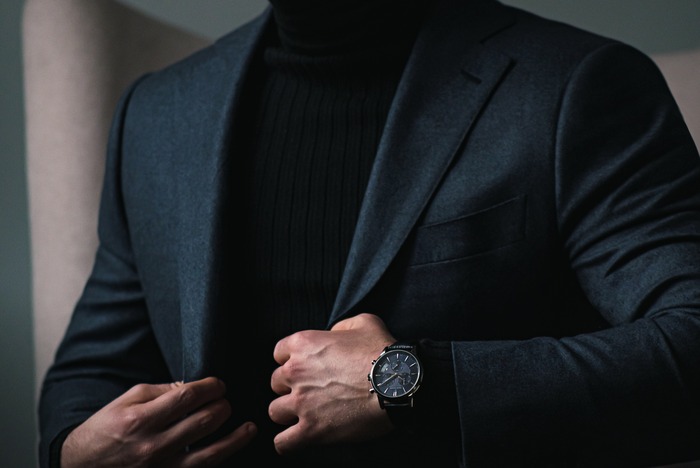
One entry in the Swiss commercial register, dated 13 September 1973, is worth looking up. Claude Bernard watches are Swiss made timepieces from a house founded that year, still owned by the Strambini family, and assembled by hand in the Jura village of Les Genevez. Prices run from roughly CHF 190 to CHF 800. The trademark itself followed in December 1979.
That date is the whole story, though almost nobody in the trade has checked it.
How one family ended up with both names
By 1983 Swiss watchmaking was on its knees. Quartz had taken the industry apart in a decade. Factories were closing across the Jura arc. ASUAG, later folded into Swatch Group, was selling off what it could no longer carry. One of the names on the block was Edox, founded in Biel in 1884 by Christian Ruefli-Flury.
Victor Strambini bought it. He was not a group and he was not a speculator, and he did not leave the brand where he found it. He moved Edox up into the Jura, to Les Genevez, where it has been made ever since. The rescue ran uphill.
He had a reason to choose that village. The company holding the Claude Bernard trademark had been entered on that register ten years earlier, on 13 September 1973. The brand states the Strambini family has owned it ever since. Read the sequence again, because most of the trade has it backwards. Claude Bernard was not invented afterwards as a cheaper wing of a famous name. It was already there when the famous name needed somewhere to go.
Four decades on, both brands still sit inside a single private business run by the same family. Victor’s son Alexandre Strambini leads it today, and the register lists him alongside other family signatories. No licensee sits in the middle, and no group treasury decides which of the two gets protected.
What happens inside the atelier at Les Genevez
Watchmaking took root in these hills as winter work, done in farmhouses when frost closed the fields. Les Genevez is a small village up there. Everything the company sells is put together there.
Staying put became a harder decision on 1 January 2017, when the Swiss made ordinance tightened. A watch now needs 60 per cent of its production cost incurred in Switzerland, and the movement must clear that bar on its own, up from 50. Casing up and final inspection still have to happen on Swiss soil, and research, development and certification costs now count toward the total.
Those rules landed hardest at the bottom of the market, exactly where margins are thinnest. Several familiar names quietly moved assembly to Asia or stopped printing the words on the dial. Claude Bernard went the other way. By its own account every movement comes from Switzerland, every case is closed in the company’s own workshop, and sapphire glass replaces mineral crystal across the range.
Sapphire is the detail that outlives the sale. Below CHF 300 it is still uncommon, and a customer who has scratched a previous watch grasps the difference in about ten seconds.
What Claude Bernard makes today
The range runs to roughly 224 references across seven collections, which is broad for a company this size. For a jeweller it means one supplier can cover several jobs in the showcase at once.
| Collection | Models | Showcase role |
|---|---|---|
| Slim Line | 47 | Thin dress watches, gifting |
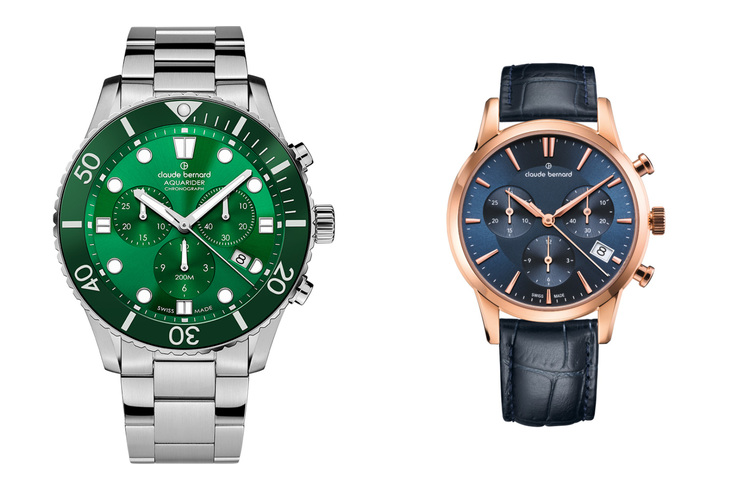
| Aquarider | 47 | Sport and water resistance |
| Dress Code | 36 | Formal and occasion |
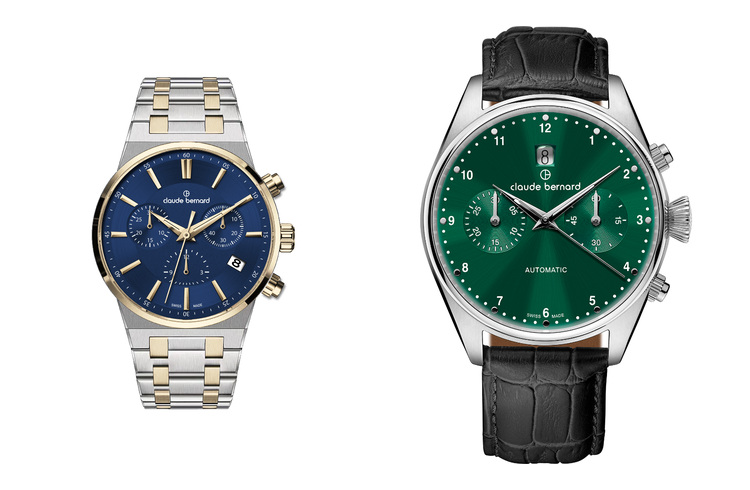
| Proud Heritage | 33 | Aviation styling, automatics |
| NEO 1973 | 24 | Heritage design, named for the founding year |
| Ora Vera | 23 | Contemporary everyday |
| Classic | 14 | Core traditional |
The complications stay legible: date, moon phase, open heart and skeleton dials on the automatics. That restraint is deliberate. A buyer at this level wants something alive under the crystal, not a specification argument. Canadian dollar pricing and a dealer locator sit on Claude Bernard North America.
Where the money is actually moving in Swiss watches
Swiss exports closed 2025 at 25.6 billion francs, down 1.7 per cent, with volume off 4.8 per cent to 14.6 million watches. The headline hides the interesting part.
| Segment | Full year 2025 | June 2026 |
|---|---|---|
| Under CHF 500 | Down 4.5 per cent | Up 54 per cent |
| CHF 500 to 3,000 | Stable | The only segment down |
| Over CHF 3,000 | Down 1.9 per cent | Strong growth |
| All exports | CHF 25.6 billion, down 1.7 per cent | CHF 2.4 billion, up 11.2 per cent |
The weakest segment of 2025 became the strongest mover of June 2026. First half exports were flat at 12.8 billion francs, so this is not a rising tide. Money is leaving the middle and collecting at both ends of the counter.
Claude Bernard straddles that boundary. Its quartz pieces open below CHF 500 and its automatics climb into the band above, an unusually useful place to stand right now.
What the Canadian numbers show
Clean Canadian data on watches does not exist, and saying so beats dressing up a proxy. Statistics Canada buries watches inside a single category with clothing, accessories, shoes, jewellery, luggage and leather goods. The Federation of the Swiss Watch Industry leaves Canada out of its headline market table. What follows is the best available read.
| Canadian indicator | Figure | Period |
|---|---|---|
| Total retail sales | $74.3 billion, up 0.6 per cent | June 2026 |
| Clothing, accessories, jewellery, luggage and leather goods | Up 3.1 per cent, third biggest subsector gain in the country | June 2026 |
| Jewellery, luggage and leather goods sales | $457 million, up 5.9 per cent on the year | April 2026 |
| Canadian jewellery industry revenue | $5.7 billion | 2023 |
Retail Insider’s second quarter review describes a country pulling apart into two shopping economies. At one end, Chanel, Hermès and Michael Hill all committed to new Canadian space this year. At the other, a large and growing group of value-conscious buyers moved toward lab-grown diamonds and accessible premium brands. Whatever is hollowing out the mid market is clearly not a Swiss phenomenon.
What makes Claude Bernard different
Strip away the history and one thing remains: a fully Swiss watch, made start to finish in one workshop, at a price a first-time buyer can reach. That used to be an ordinary proposition. Canadian retailers have watched it thin out for a decade. We examined that pressure in our reporting on Swiss watch exports and Canada’s luxury market. The scarcity is now the argument for stocking it.
Independence explains the survival. A listed company facing a cost squeeze at CHF 200 retail moves the work offshore because a board asks it to. A family that has held one village address for more than fifty years answers to nobody, and answers slowly.
There is industrial weight behind the smaller name as well. Edox produces between 30,000 and 40,000 watches a year on Ronda quartz and Sellita automatic calibres, reaching more than 60 markets and roughly 1,000 points of sale. The watchmakers who build those watches work in the same building. A jeweller taking on Claude Bernard inherits that capability, and a single address for service.
The last piece is the story. Thirty seconds is enough to tell it across a counter, and it holds up when the customer looks it up on the drive home.
Four moves for the week ahead
Count the Swiss made pieces on the floor under $1,000 retail. If the answer is fewer than six, the fastest moving part of the export market has no representation in the store.
Check the crystal on every quartz model under $500. Where it is mineral, a competitor has an argument you cannot answer.
Give the staff the 1983 rescue to tell. Thirty seconds of real history turns a price objection into a conversation about where the watch came from.
Move an accessible Swiss automatic into the bridal case instead of the watch wall. Groomsmen and anniversary gifting sit squarely in this price band, and that traffic is already walking past it.
Frequently asked questions
Are Claude Bernard watches genuinely Swiss made?
Yes, and the label is a legal test rather than a claim a brand awards itself. What it does not promise is a watch made entirely of Swiss parts. It sets a floor, not a ceiling, which is why two watches carrying the same two words can be built very differently.
Who owns Claude Bernard, and how is it connected to Edox?
The Strambini family, privately, with no outside investors. They bought Edox in 1983 and have run both names from one building ever since.
What do Claude Bernard watches cost?
About CHF 190 at the entry point, about CHF 800 at the top, which puts the range either side of the CHF 500 line dividing the two Swiss export segments. Canadian retail is set by the dealer.
Where can Canadians buy Claude Bernard?
Through authorised jewellers. Claude Bernard North America lists the range in Canadian dollars and runs a store finder for local retailers.
Why does the affordable Swiss segment matter to Canadian jewellers in 2026?
Because that is where the growth is. The cheapest Swiss watches were the weakest export category of 2025 and the strongest of June 2026, while Canadian jewellery retail expands at the accessible and luxury ends and stalls in between.
Sources: Claude Bernard; Claude Bernard North America; Swiss commercial register via Moneyhouse; Edox; Europa Star; Federation of the Swiss Watch Industry; FH Swiss made criteria; Statistics Canada; Retail Insider.

Author: Olivier Fel.
Olivier Felicio is the founder and publisher of Canadian Jeweller Magazine, Canada's jewellery business publication since 1879. He writes on retail strategy, market data, trade policy and the commercial side of the Canadian jewellery and watch trade, and hosts Time and Shine, Canada's jewellery buying event. Contact: olivier@canadianjeweller.com.


