







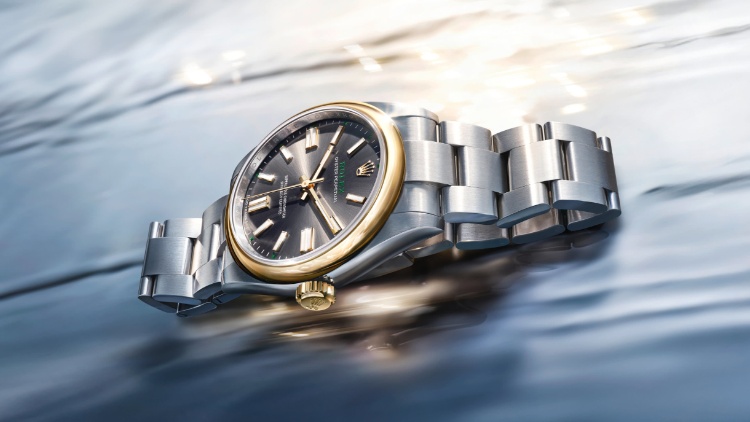
The Rolex Oyster 100 years programme centres on a yellow Rolesor Oyster Perpetual 41 rather than a solid gold piece, and the Swiss export figures explain the choice better than the anniversary does.
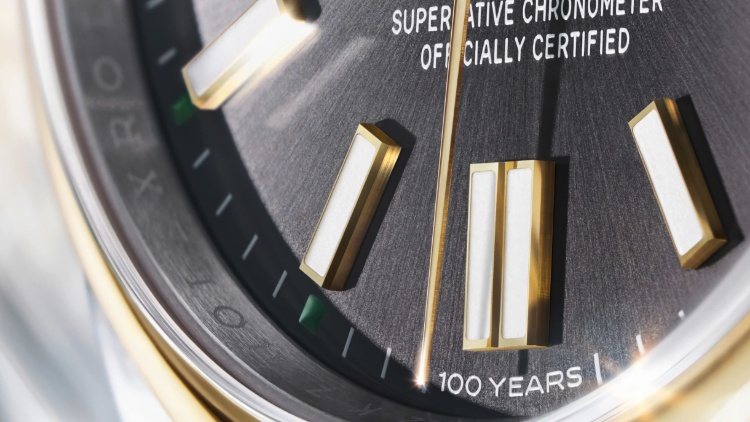
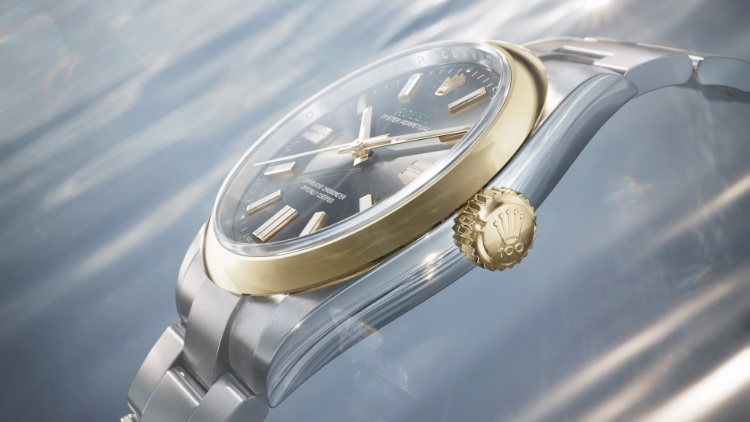
Steel case, steel bracelet, gold bezel, a gold winding crown carrying the number 100. On the slate dial, the words “100 years” sit at six o’clock in the position normally held by “Swiss Made”. For a centenary, solid gold would have surprised nobody. Rolex went the other way, and the reason is sitting in a spreadsheet.
What did Rolex actually release for the centenary?
The anniversary family runs across four sizes. Reference M134303-0001 is the one carrying the weight of the campaign: an Oyster Perpetual 41 in yellow Rolesor, calibre 3230, at roughly US$9,650. Alongside it came a 36 in Oystersteel with a multicoloured Jubilee motif dial near US$7,050, a 34 in 18 ct Everose with a blue stone lacquer dial at about US$38,100, and a 28 in yellow gold at around US$30,000.
All of them carry the reinforced Superlative Chronometer certification introduced in 2026, which adds resistance to magnetism, reliability and sustainability as criteria applied during design and manufacturing. The 2015 standard governing precision, waterproofness, self-winding and power reserve on the finished watch stays where it was.
Why does the metal matter more than the anniversary?
Because bimetal is the only material category currently taking units and value at the same time.
| Month, 2026 | Bimetal, value | Bimetal, volume | Precious metal | Steel |
|---|---|---|---|---|
| January | CHF 410.9m, up 16.1% | 107,100 units, up 45.1% | CHF 618.8m, down 14.0% | CHF 627.3m, down 4.5% |
| February | CHF 436.3m, up 38.4% | 98,700 units, up 31.8% | not gaining | value down 4.6%, volume up 11.3% |
| June | up 42.1% | value up 5.0%, volume up 7.0% |
Read the steel column carefully, because it is the one that gets misread. Volumes rose while value per unit slipped. That is demand sliding toward entry references, not a healthy steel market. Gold, meanwhile, shed value outright.
Total Swiss watch exports for the first half of 2026 came in at CHF 12.8 billion, down 0.7 per cent. Flat on the surface. Underneath, the materials pulled apart, and the customer who used to reach for a gold watch did not leave the category. They moved one shelf over.
What does the price step between steel and Rolesor tell a retailer?
Put the two Oyster Perpetual 41 references side by side. The steel version sits near US$7,920. The centenary Rolesor lists at US$9,650. Roughly US$1,730 separates them, and that money buys a gold bezel and a gold crown. Case size, calibre and bracelet metal do not change.
Call it a 22 per cent step to reach a gold price point. Nowhere else in a watch case is gold that cheap to put in front of a customer.
Rolex’s own 2026 price list leans the same way. Steel references rose 1 to 3.5 per cent, Rolesor 4.5 to 5 per cent, solid gold 5 to 6 per cent, platinum 3.5 per cent. The increase tracks gold content almost exactly, which would be unremarkable except for what the export data says next to it: buyers absorbed the rise on the two tone and walked away from the solid gold.
How should a Canadian store change its watch buy?
Treat it as a capital question rather than a taste question.
One solid gold showcase piece at $12,000 costs the same money as three two tone pieces at $4,000. The single piece gives you one opportunity to sell at a price point that is contracting, one facing, and a slow read on whether the customer wanted it. Three pieces give you three opportunities at the price point gaining on both measures, three facings, and a much faster read. On a case that turns slowly, that read is worth more than the margin on any one sale.
Substitute your own numbers. If your average two tone retail is $2,800 rather than $4,000, the same $12,000 buys four pieces instead of three, and the argument gets stronger, not weaker.
Then count your facings. Where two tone is in single digits as a share of the watch case, the case is weighted against the only thing currently growing.
What should suppliers and wholesalers take from it?
The same arithmetic, run backwards, decides which references deserve metal committed to them for the next production cycle.
There is a second lever in the Rolex numbers worth testing on your own lines. The Rolesor step on the Oyster Perpetual 41 is about 22 per cent over the steel equivalent. Where that step climbs past roughly 30 per cent, the customer stops reading it as a steel watch with gold on it and starts reading it as a gold purchase, which is the decision they have been avoiding. Price architecture, not category appetite, is the more likely reason a two tone line has gone quiet.
What Canadian data exists on this, and what does not?
Very little, and it is better to say so than to paper over it with American figures.
The Federation of the Swiss Watch Industry publishes no Canadian line in its monthly market tables, so there is no domestic import figure to quote. Statistics Canada is no more help, because watches are folded into NAICS 4583 alongside luggage and leather goods, which means no standalone Canadian watch retail series and no Canadian sell-through figure for two tone exists at all.
What can be said is that Canadian buyers order out of the same Swiss production these export figures describe, and the same allocation decisions determine what lands in Canadian cases. Global export data is a proxy here. It is the honest one, and it is the only one available.
Frequently asked questions
Is export data the same as sell-through?
No. Exports measure what left Switzerland, so the figures read allocation rather than consumer demand. That distinction matters, and it also has limits: one month of movement can be inventory build, but three consecutive months moving the same direction on units and on value at once is difficult to explain that way.
Does any of this apply to a store that will never hold a Rolex account?
Rolex is the illustration rather than the lesson. The bridge price point between steel and gold is where the units went, and that holds across every watch line a Canadian store can actually buy, as well as a good deal of the jewellery case.
What changed in the Superlative Chronometer certification in 2026?
Three criteria were added at the design and manufacturing stages: resistance to magnetism, reliability and sustainability. The tests on the finished watch for precision, waterproofness, self-winding and power reserve introduced in 2015 continue unchanged, so the green seal now certifies process alongside performance.
More watch business coverage sits in the Canadian Jeweller watch section. Full details of the centenary references are published on the Rolex newsroom.
Subscribe to Canadian Jeweller for more market intelligence built for the trade.

Author: Olivier Fel.
Olivier Felicio is the founder and publisher of Canadian Jeweller Magazine, Canada's jewellery business publication since 1879. He writes on retail strategy, market data, trade policy and the commercial side of the Canadian jewellery and watch trade, and hosts Time and Shine, Canada's jewellery buying event. Contact: olivier@canadianjeweller.com.


