







Swiss Watch Exports Just Slipped — And the Middle East Is to Blame
War, Gold Prices, and Shifting Markets Are Rewriting the Rules for Every Watch Retailer in Canada
The Swiss watch industry is nothing if not resilient. It has survived recessions, pandemics, the rise of the smartwatch, and the slow erosion of its Chinese markets. But March 2026 handed it a new set of headaches: an active conflict in the Middle East, gold prices hovering near record highs, and a global consumer who has become far more selective about where and why they spend on luxury.
The numbers, released Tuesday by the Federation of the Swiss Watch Industry (FH), tell a story that is neither catastrophic nor comfortable. Swiss watch exports slid 1% in March compared with the same period last year. That is a modest decline on paper, but the detail behind the headline is what should hold the attention of every Canadian watch retailer.
What Actually Happened in March 2026
The single biggest drag on March performance was the Middle East. Saudi Arabia recorded a 16.8% drop in Swiss watch imports, while Qatar saw an almost 25% decline — both extending a weakening trend that began as far back as January. Analysts at Vontobel were blunt in their assessment, noting that March export figures are not a clean read on actual end-demand in the region, with luxury sell-out data suggesting a far steeper contraction closer to 50% in some markets.
The United Arab Emirates held up relatively well, posting a modest 0.7% increase, but the broader Gulf picture is fragile. In 2025, the Middle East had been one of the genuine bright spots for watchmakers, with the Gulf region touching CHF 2.21 billion in Swiss watch imports for the full year. That tailwind has now turned.
Germany added further pressure, falling 8.5%, while Japan dropped 12.6% year over year in March. These are not small numbers in markets that watchmakers have historically counted on for steady, reliable volume.
On the positive side, Singapore rose 4.9%, China gained 4.2%, the United Kingdom was up 3.2%, and Hong Kong edged 0.5% higher. France posted a headline-grabbing 72.4% increase, but the FH was quick to clarify that this reflects re-exports to other destinations rather than any genuine surge in French consumer demand.
The U.S. market, which now stands as the industry’s largest single destination, fell 1.6% in March after recording a strong 26.8% gain in February. That kind of month-to-month swing is becoming characteristic of a market still absorbing the aftershocks of last year’s tariff disruptions.
The only segment to genuinely grow in March was watches priced between 200 and 500 Swiss francs — roughly CAD $290 to $720 at current exchange — up 15.4%. Every other price tier saw contraction.
Putting March in Context: The Q1 2026 Picture
Taken in isolation, March looks worrying. Placed against the broader first quarter of 2026, the story is more measured. Total Swiss watch exports for Q1 2026 reached CHF 6.2 billion (approximately CAD $10.8 billion), representing a 1.4% improvement over the same quarter in 2025. The U.S. was up 2.8% for the quarter overall. China and Hong Kong, despite their individual monthly volatility, showed signs of stabilisation compared with their dramatic declines of the prior two years.
Mario Ortelli, managing partner of London-based luxury strategy firm Ortelli & Co., noted that first-quarter results across major luxury conglomerates including LVMH, Kering, and Hermès point toward a broader industry truth: watches and fine jewellery — products with long life cycles and genuine resale value — are outperforming softer luxury categories. Consumers are shifting toward investment pieces that are iconic and enduring.
How 2026 Compares to 2025 — and the Trend That Matters
To understand March 2026, you need to understand what 2025 actually was for Swiss watchmaking. It was not a good year by the standards the industry had set for itself.
Full-year 2025 Swiss watch exports came in at CHF 25,552 million — down 1.7% from 2024 and down 4.5% from the record year of 2023. Volume fell even more sharply, with units exported dropping 4.8% to 14.6 million pieces. The industry was producing fewer watches and selling them at higher prices, which is a deliberate strategic shift but also a sign of shrinking accessible demand.
The U.S. story in 2025 was defined by extreme volatility. April 2025 alone saw a 150% surge in exports as manufacturers front-loaded shipments ahead of anticipated tariff increases. By August, after the White House confirmed a 39% tariff on Swiss goods effective August 7, 2025, exports to the U.S. collapsed — down 56% in September 2025 alone compared with the prior year. The full-year U.S. figure still ended at roughly -2.1%, a testament to how aggressively the industry pulled forward demand in early 2025.
China contracted 12.1% for the full year 2025, extending a two-year decline that has erased more than a third of its export volume compared with 2023 levels. Hong Kong fell 6.5%. Japan dropped 5.8%. These are the three markets that defined Swiss watchmaking’s golden decade, and all three are now in sustained retreat.
Meanwhile, as U.S. tariffs began biting in August 2025, two neighbouring markets saw an unexpected benefit. Canada and Mexico both recorded impressive growth in September 2025, as buyers and potentially some grey-market activity shifted across the border. Canada specifically came in at 19th globally in FH’s annual export rankings, with CHF 309.1 million in Swiss watch imports for 2025 — up 4.5% from 2024 and 3.7% from 2023. That is a meaningful and consistent upward trend that positions Canada as a quietly growing market.
Note: Country-specific data for Canada’s March 2026 Swiss watch import figures was not available at the time of publication. Canadian import statistics from Statistics Canada for this period have not yet been released. The 2025 full-year figure of CHF 309.1 million is the most current confirmed benchmark.
The Gold Problem No One Wants to Talk About
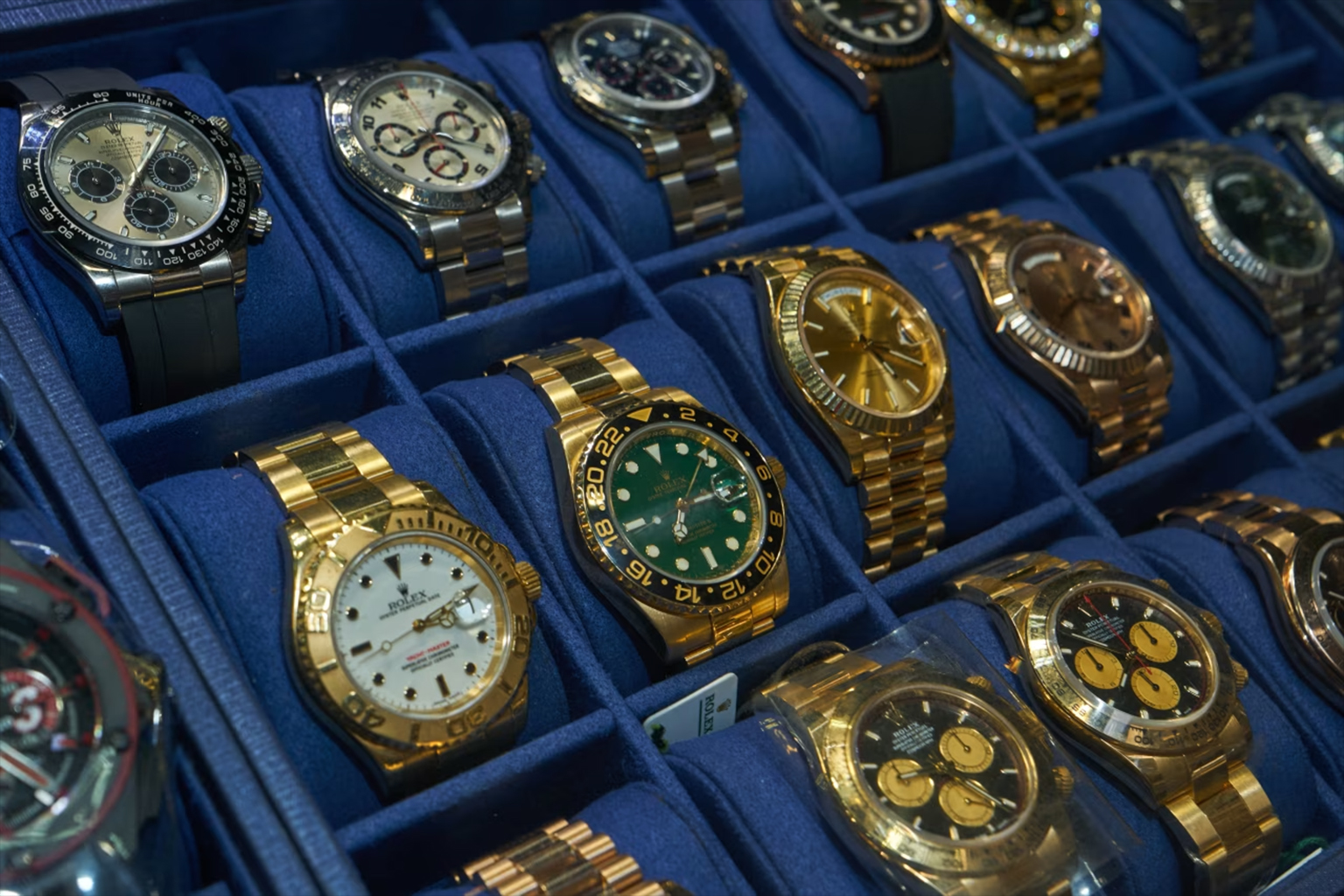
Beyond geopolitics, there is a structural cost issue that is reshaping what Swiss watchmakers are actually making and selling. Gold prices have surged well past previous highs, reaching above USD $4,500 per ounce by late 2025 — up from roughly $2,650 in Q4 2024. Swiss watch retail prices have risen accordingly, with Rolex prices climbing an average of 15% between December 2024 and January 2026. Gold-case references saw increases closer to 20%.
Several watchmakers, including H. Moser & Cie and Favre Leuba, have publicly stated they are actively reducing gold in their collections, focusing it only on references where the material is genuinely integral to the design. Steel sports watches fell 9% in March 2026 exports, partly because high metal costs are squeezing margins across the board and partly because the consumer market for entry-to-mid luxury steel sports references has cooled from its pandemic-era peak.
For Canadian retailers, this creates a sharper conversation with clients. A watch that cost CAD $12,000 eighteen months ago may now carry a sticker that reads CAD $14,500 or higher. That gap requires storytelling, provenance, and confidence — not apology.
What Canadian Jewellers Should Be Watching
The broader picture for Canadian watch retailers entering the second quarter of 2026 is one of selective pressure rather than collapse. The ultra-high end — pieces above CHF 3,000 export value — continues to attract serious collectors. The secondary and certified pre-owned market is gaining institutional legitimacy, with major maisons now operating their own CPO programmes. Secondary prices rose 4.9% in 2025 after two consecutive years of declines, a signal that collector confidence is rebuilding.
The mid-tier, however, is being hollowed out. Entry-level Swiss is getting thinner on the ground as brands deliberately prune lower-margin references and tighten allocations. Canadian retailers who built their watch floors around accessible Swiss volume are finding fewer options and less margin room.
The opportunity lies in positioning. Canada’s watch retail environment is not facing the structural disruption hitting the U.S. tariff regime or the consumer confidence crisis in China. The Canadian dollar, while under its own pressures, has not swung as dramatically as the yen, which has further complicated Japanese retail pricing. Canada is, relatively speaking, a stable and growing market for Swiss timepieces — but only for retailers who understand how to hold price, tell a story, and move away from a warehouse mentality toward a curated, point-of-view approach to their floor.
Canadian Jeweller Magazine and the Time & Shine International Expo remain the definitive platforms connecting watch brands with the Canadian retail community. As Swiss brands recalibrate their global distribution strategies and focus on markets showing consistent growth, being visible, credible, and connected within the Canadian industry has never mattered more.
Subscribe to Canadian Jeweller for more industry intelligence, market analysis, and the news that matters to your business.
Sources: Federation of the Swiss Watch Industry (FH), Bloomberg, Monochrome Watches, Watch Collecting Lifestyle, United Nations COMTRADE, JCK, WatchPro, Ortelli & Co. Canadian-specific March 2026 import data unavailable at time of publication; most recent confirmed benchmark is full-year 2025 FH statistics.


