







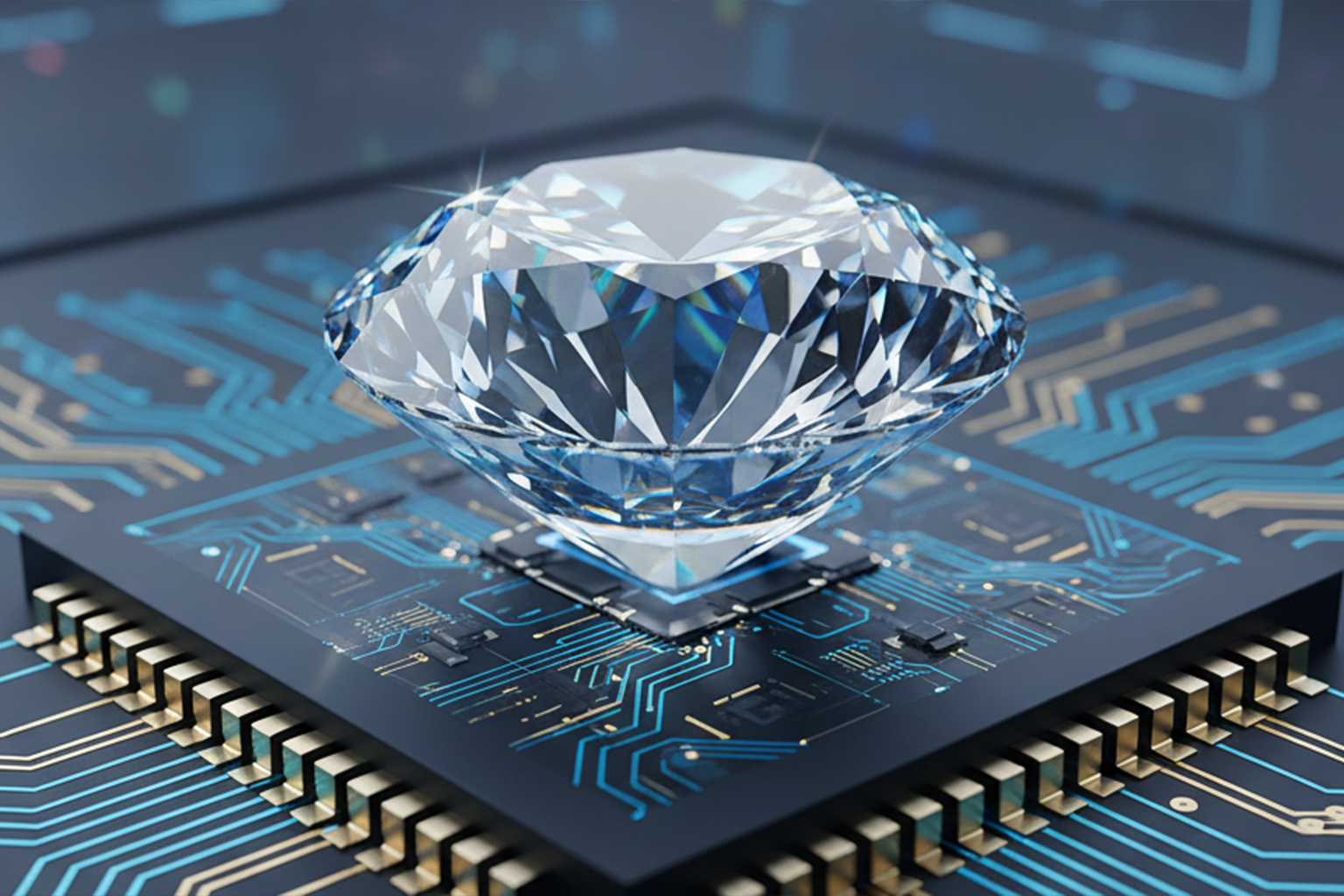
Something shifted in the diamond market at the start of 2026, and it was not driven by a surge in engagement ring sales or a De Beers marketing campaign. It was driven by silicon.
In March 2026, leading Chinese lab-grown diamond producers began voluntarily raising rough prices by roughly 15%, breaking the long price-decline stalemate that had defined the industry for the better part of three years. Reports from industry sources in China, corroborated by Jin10 financial data, indicate that both industrial diamonds and lab-grown diamond roughs saw increases in the range of 10% to 15% — a meaningful reversal after a prolonged period of oversupply and price compression.
For Canadian jewellery retailers and wholesalers, this is not background noise. This is a structural market shift worth understanding before the next buying cycle.
What Is Actually Driving the Price Increase
The answer sits at the intersection of materials science and the global AI boom.
Single-crystalline diamond offers some of the highest thermal conductivity recorded in any material, reaching 2,200 to 2,400 watts per metre per kelvin — roughly six times as conductive as copper. In an era where leading AI chips are operating at power draws above 700 watts per unit, and data centres are consuming electricity at rates that have utilities struggling to keep pace, that thermal property is no longer a gemological curiosity. It is an engineering necessity.
Researchers at Stanford University have managed to grow a form of diamond suitable for spreading heat directly atop semiconductor devices at low enough temperatures that even the most delicate interconnects inside advanced chips survive. This breakthrough, published in the November 2025 issue of IEEE Spectrum, essentially confirmed what materials scientists had been theorising for years: diamond is not just jewellery. It is the most effective heat-management material available, and the semiconductor industry is starting to act on that.
Lab-grown diamond heat spreaders are emerging as the most effective bulk thermal conductor available, complementing liquid cooling and immersion systems to manage heat at the source — with early deployments already showing lower hot spot temperatures, reduced cooling overhead, and improved system reliability.
The global diamond heat spreaders market is expected to rise from USD 0.35 billion in 2025 to USD 0.75 billion by 2035, representing a compound annual growth rate of 7.83% over that period. That is a market growing from scratch, and the raw material feeding it is the same CVD and HPHT lab-grown diamond rough that the jewellery industry has been sourcing for bridal and fashion jewellery.
China’s Position — And Why It Matters for Pricing
China’s dominance in lab-grown diamond production is not a minor detail. China produced approximately 22 million carats of lab-grown diamonds in 2024, a 144% year-on-year increase, accounting for 63% of global output according to the Gems and Jewelry Trade Association of China.
The Chinese Academy of Sciences has successfully produced 4-inch ultra-thin diamond films for chip cooling with thermal conductivity five times greater than copper — a development that places the upstream producers, already dominant in rough supply, now squarely in the conversation around advanced materials for technology applications.
The supply-demand equation has shifted as a result. When the same rough material serves both the bridal market and the semiconductor thermal management sector, demand diversification puts upward pressure on price. Industry analysts have noted that the 10–15% price increase in early 2026 is the critical first step of the industry rescuing itself from a prolonged race to the bottom — and that only once prices stop falling will consumer confidence in the product stabilise.
This is precisely why the increase is not a temporary spike. It reflects a change in how diamond is perceived at the industrial level — from a jewellery commodity to what analysts are now calling a high-growth new materials asset.
Note: Specific Canadian data on domestic pricing impacts from this development is not yet available at the time of publication. Canadian wholesalers are advised to monitor their international supplier pricing closely over the next two quarters.
What This Means for Canadian Retailers and Wholesalers
The short answer is: your cost base for lab-grown diamond inventory is likely to increase, and the story you tell customers about lab-grown diamonds just got more compelling.
For years, the retail challenge with lab-grown was positioning — how do you justify a price when consumers could see it falling almost quarterly? The technology narrative changes that conversation. Diamond is no longer simply a less expensive alternative to a mined stone. It is now a material that cools the chips inside the devices your customers use every day. It carries a technological legitimacy that no marketing campaign could manufacture.
The bridal market currently accounts for 40% of lab-grown diamond demand, with engagement ring buyers increasingly choosing lab-grown for size maximisation within budget constraints. Self-purchase fashion represents 35% of demand and is posting the strongest annual growth at 15–20%. The technology applications opening up represent a third lane of demand — industrial and semiconductor — that does not compete with the jewellery market but does tighten supply at the rough level.
The synthetic diamond market is projected to grow from USD 27.2 billion in 2025 to USD 44.8 billion by 2035. That is a market with room for both jewellery and technology applications — but it is a market where pricing will stabilise upward rather than continue the downward trajectory retailers had come to rely on.
What the first quarter of 2026 makes clear is that diamond — particularly lab-grown diamond — is in the early stages of a category redefinition. Demand for 5G and 6G base-station components, battery gigafactories, and quantum-sensor prototypes is expanding revenue opportunities well beyond the traditional jewellery segment.
Industry analysts note that diamond’s first large-scale technology impact will be through integration into existing systems rather than absolute replacement of silicon or silicon carbide. The timeline for full semiconductor adoption is still measured in years, but the directional shift is not in question.
For the Canadian jewellery trade — retailers, wholesalers, and designers alike — the takeaway is straightforward. The material at the centre of your business is also at the centre of one of the most significant technology transformations of the decade. That is a story worth telling, and a price movement worth preparing for.
Note: Specific Canadian domestic pricing data on the impact of this price increase was not available at the time of publication. All pricing figures cited are based on verified international market data. Canadian wholesalers are encouraged to consult directly with their suppliers for region-specific guidance.


