







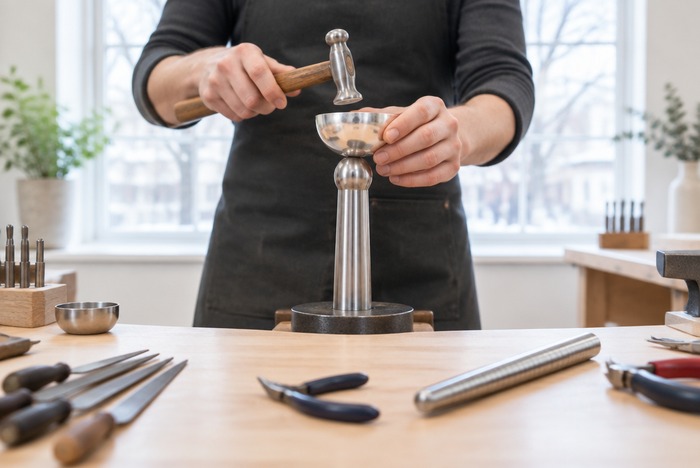
147 Years of Canadian Jewellery Design · Part 3 of 5
- Part 1: The Engraved Cuff
- Part 2: Metal With a Past
- Part 3: The One Person Studio (you are here)
- Part 4: Stones With a Canadian Address (publishes Thursday 1 October)
- Part 5: The Nation’s Jewel (publishes Friday 2 October)
Most Canadian studio jewellers work alone. In June 2026, Statistics Canada counted 1,125 jewellery and silverware makers with no employees, while 233 of the 325 firms that do employ staff had between one and four people. The tradition runs from a 1930s Toronto basement to today’s solo benches.
In 1932, a young Toronto silversmith named Harold Stacey did some arithmetic. He could earn eighteen cents an hour working for someone else, or fifteen cents an hour working for himself. He took the pay cut. His workshop was a basement that broke the residential zoning bylaw, and the house rang with hammering day and night.
Part two of this series followed the metal. This part follows the hands. Stacey’s choice, independence over a slightly better wage, has been made by Canadian jewellers in every decade since.
How did the studio jeweller tradition grow in Canada?
- 1932. Stacey opens his basement bench. Silver costs about 50 cents an ounce, and gold is out of reach.
- 1936. The dealer Douglas Duncan gives Stacey space in the Picture Loan Society building, where the painter David Milne also works.
- 1938. John and Nancy Meek Pocock open a Toronto studio, described at the time as the only one of its kind in Canada.
- 1946. The Metal Arts Guild forms in Toronto. Its five founding directors include a solicitor and a salesman, and it models itself on London’s Goldsmiths’ Company.
- 1954. Toni Cavelti, a Swiss goldsmith, arrives in Vancouver with $8 and his tools. Karl Stittgen, from Germany, starts working there the same year.
- 1959. The Guild’s annual show tours Canada with support from the National Gallery.
- 1961. Cavelti is the only Canadian exhibitor at Goldsmiths’ Hall in London.
- 1964. Walter Schluep, born in Spain in 1931, opens his own studio in Montreal.
- 1973. Madeleine Dansereau and Armand Brochard open an atelier in Old Montreal that becomes the École de joaillerie de Montréal.
- 1978. Lois Etherington Betteridge of Guelph becomes the first metalsmith to win the Saidye Bronfman Award.
- 2008 to 2022. Six more jewellers and metalsmiths win it: Chantal Gilbert, Kye-Yeon Son, Charles Lewton-Brain, Paul McClure, Pamela Ritchie and Brigitte Clavette.
Stacey, for his part, hated teaching and did it only for money. Even so, generations of Canadian makers passed through a classroom like his.
What is happening to jewellery training in Canada?
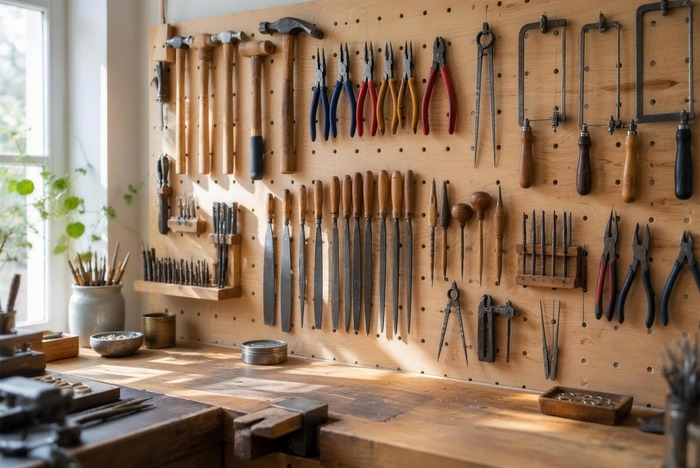
The irony, however, is sharp. Paul McClure, the 2015 Bronfman laureate, has taught jewellery at George Brown in Toronto since 2000 and has coordinated the program since 2014. In April 2025, George Brown suspended three of its four jewellery programs from that fall, citing low enrolment and the cap on international students. Its surviving Jewellery Essentials certificate is now listed as closed for the fall 2026 intake.
Moreover, Toronto is not alone. Craft Ontario reported in 2025 that Sheridan suspended its entire Craft and Design intake and that OCAD University was sharply reducing jewellery courses. Programs remain open at NSCAD in Halifax, AUArts in Calgary, Vancouver Community College, Georgian College in Barrie and the jewellery schools in Montreal and Quebec City.
Still, for makers already working, Harbourfront Centre in Toronto still runs a craft residency that includes metal and jewellery. Residents pay a licence fee of $110.70 a month, and the next application window opens in October 2026.
What does a Canadian studio jeweller earn?
Job Bank publishes wages for jewellers from 2024 data. The national median is $22.45 an hour. In Ontario, 61 per cent of jewellers are self employed, compared with 15 per cent across all occupations. Several provinces have too little data to publish.
| Region | Low | Median | High |
|---|---|---|---|
| Canada | $16.09 | $22.45 | $35.86 |
| British Columbia | $19.08 | $24.18 | $41.22 |
| Ontario | $17.60 | $22.91 | $41.00 |
| Alberta | $15.66 | $22.70 | $35.28 |
| Quebec | $17.08 | $20.77 | $36.25 |
Hourly wages, jewellers and related occupations, Job Bank, 2024 data.
A 2024 study by the Canadian Crafts Federation adds context, although it does not separate jewellery from other crafts. It put the median craftsperson’s income at $20,500 in 2019 and found consignment pays makers between 50 and 75 per cent of retail. The Alberta Craft Council’s gallery shop, for example, pays 60 per cent to the artist.
Overall, the counts suggest the solo model is growing. Statistics Canada recorded 897 makers with no employees in December 2020, against 1,125 in June 2026, although it cautions against reading business counts as a time series.
What should retailers do when working with studio jewellers?
Put the terms in writing. Set the consignment split, monthly settlement, insurance and return date on paper. On proven pieces, buy outright at wholesale so the maker is paid on delivery.
Recruit from the pipeline that remains. Harbourfront residents, NSCAD graduates and students from the Montreal and Quebec City schools are looking for trunk shows and custom bench partners.
Sell the maker along with the piece. Awards, museum holdings and a studio story give independent work its premium. Furthermore, pieces by named Canadian makers such as Cavelti already resell at auction.
Finally, studio jewellers have also given the country something harder to count: stones and metal that carry a Canadian address. Part four follows the gems that only Canada can claim.
Next in the series: Part 4, Stones With a Canadian Address, publishes Thursday 1 October.
Frequently asked questions
How many independent jewellers are there in Canada?
Statistics Canada counted 1,125 jewellery and silverware makers with no employees in June 2026, plus 325 employer firms, 233 of which had one to four staff.
Who has won the Saidye Bronfman Award for jewellery?
Eight laureates work in jewellery or metal: Lois Etherington Betteridge (1978), Bill Reid (1986), Chantal Gilbert (2008), Kye-Yeon Son (2011), Charles Lewton-Brain (2012), Paul McClure (2015), Pamela Ritchie (2017) and Brigitte Clavette (2022).
Where can you study jewellery making in Canada in 2026?
Programs are active at NSCAD, AUArts, Vancouver Community College, Georgian College and the jewellery schools in Montreal and Quebec City. George Brown suspended three of its four programs in 2025.
What is the Metal Arts Guild?
Founded in Toronto in 1946, it brought Toronto’s studio metalsmiths together under one banner. Its early juried exhibitions were held at the Royal Ontario Museum.
What consignment split do Canadian craft galleries pay?
Makers usually receive between 50 and 75 per cent of the retail price. The Alberta Craft Council’s gallery shop pays 60 per cent.
Sources: Ganoksin, Harold Stacey · Ganoksin, Metal Arts Guild · James Evans, contemporary Canadian jewellery · City of Vancouver Archives, Toni Cavelti · BC Achievement, Karl Stittgen · The Globe and Mail, Walter Schluep · École de joaillerie de Montréal · Canada Council, Saidye Bronfman laureates · George Brown, Paul McClure · The Eyeopener, George Brown programs · George Brown, Jewellery Essentials · Craft Ontario · Harbourfront Centre residency · Job Bank, jewellers wages · Job Bank, Ontario outlook · Canadian Crafts Federation study · Alberta Craft Council · Statistics Canada, table 33-10-1174 · Statistics Canada, table 33-10-1175

Author: Canadian Jeweller Editorial Team
The editorial team of Canadian Jeweller Magazine, Canada’s jewellery industry publication since 1879. We report on retail strategy, diamonds and gemstones, watches, precious metals, technology, and the business of jewellery across Canada. Editorial inquiries: editor@canadianjeweller.com.


