







147 Years of Canadian Jewellery Design · Part 2 of 5
- Part 1: The Engraved Cuff
- Part 2: Metal With a Past (you are here)
- Part 3: The One Person Studio (publishes Wednesday 30 September)
- Part 4: Stones With a Canadian Address (publishes Thursday 1 October)
- Part 5: The Nation’s Jewel (publishes Friday 2 October)
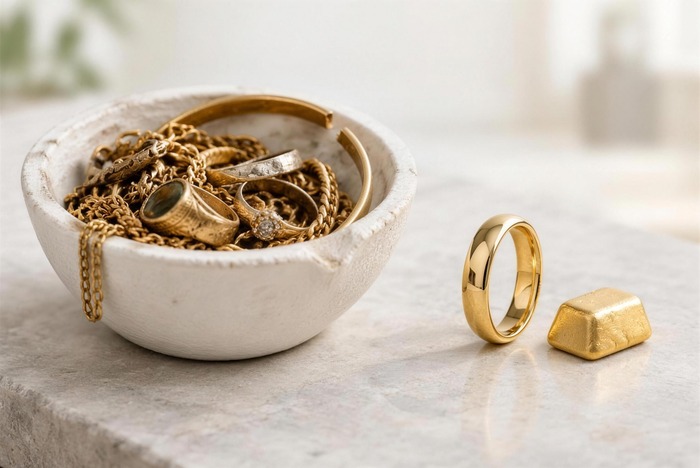
Recycled gold jewellery can be sold in Canada with a “recycled” claim, but since June 2024 that claim must rest on adequate and proper testing under the Competition Act. Penalties reach $10 million for a corporation. Meanwhile, gold’s record run has made reused metal the trade’s most valuable raw material.
On 27 January 2026, the line at Wildrose Jewellers in Calgary was made of sellers, not buyers. Gold had crossed $7,000 an ounce in Canadian dollars, nearly 80 per cent higher than a year earlier, and people arrived with inherited chains and single earrings. The next day it peaked at $7,344.62. Two days after that, the price fell about 10 per cent in a single session.
In part one, Haida smiths hammered silver dollars into bracelets because coins were the metal at hand. Since then, the same instinct returns every time gold becomes expensive. This part follows it from the Klondike to the Calgary counter.
How has recycled metal shaped Canadian jewellery?
- 1880s. Haida smiths melt American silver dollars into crest bracelets.
- 1896. Gold is found in the Klondike. The MacBride Museum in Whitehorse now holds nuggets attributed to Skookum Jim, which its director calls the only papered gold tied to a founder of the rush.
- 1911. The Royal Canadian Mint opens its refinery in Ottawa. It joins the London Good Delivery list in 1919.
- 31 October 1931. An Order in Council bans gold exports from Canada.
- 10 April 1933. Redemption of Dominion notes in gold is suspended, and Canadians are urged to hold their gold as a patriotic duty.
- 21 January 1980. Gold peaks near US$850 an ounce, a record that stands for 28 years.
- 12 March 2024. Asahi Refining Canada in Brampton earns Responsible Jewellery Council chain of custody certification.
- 14 March 2025. Gold passes US$3,000 for the first time.
- 29 September 2025. Toronto’s Mejuri, which says most of its gold is recycled, raises prices. Days later, on 8 October, gold passes US$4,000.
- February 2026. Global Affairs Canada reports that gold waste and scrap from the United States drove the largest share of that month’s import jump.
- 25 September 2026. Gold trades near US$4,298, or about $6,061 in Canadian dollars, some 17 per cent below the January peak.

What did gold’s 2025 run do to jewellery?
The World Gold Council’s full year figures tell the story. The London price set 53 record highs in 2025 and averaged US$3,431, up 44 per cent. Global jewellery demand fell 18 per cent by weight, to 1,542 tonnes. Yet its value hit a record US$172 billion. In other words, customers spent more money on less metal.
Recycling, by contrast, rose only 3 per cent worldwide, to 1,404 tonnes, with most of the increase in developed markets. Canada does not publish its own scrap volume, and no official data exists on the split between 10 and 14 karat sales here.
Take a 5 gram band at the September price. In 14 karat gold, the metal alone costs about $570. In 10 karat, it costs about $406, a difference of $164 before any markup. At the January peak, the same 14 karat band carried about $690 of metal.
| Date | Gold price | Metal in a 5 g 14K band |
|---|---|---|
| 28 January 2026 (peak) | $7,345 per ounce | about $690 |
| 25 September 2026 | $6,061 per ounce | about $570 |
| Same band in 10K, September | $6,061 per ounce | about $406 |
Canadian dollars. Metal value calculated from fine gold content; excludes labour, alloy and margin.
Can Canadian jewellers call their gold recycled?
Yes, but the rules have changed. Bill C-59 brought greenwashing provisions into the Competition Act on 20 June 2024, and the Competition Bureau issued final guidelines on 5 June 2025. A corporation now faces penalties of $10 million, or three times the benefit, or 3 per cent of worldwide revenue, whichever is greater.
Bill C-15 then received Royal Assent on 26 March 2026. It narrowed the rules for claims about a company’s overall business. However, it left product claims untouched. A “made with recycled gold” line on a ring still needs adequate and proper testing, and private parties can still challenge it before the Competition Tribunal. So far, the Bureau has published no jewellery ruling, which leaves Canadian jewellers without a precedent.
Meanwhile, the older law still applies. Under the Precious Metals Marking Act, gold can be marked from 9 to 24 karat. Tolerance is 3 parts per thousand without solder and 7 with solder. In addition, any quality mark must sit beside a registered Canadian trademark.
What should the trade do about recycled metal now?
Back every claim with paper. Keep refiner certificates, such as chain of custody documents, on file for each piece sold as recycled. If the paperwork cannot follow the metal, drop the word from the tag.
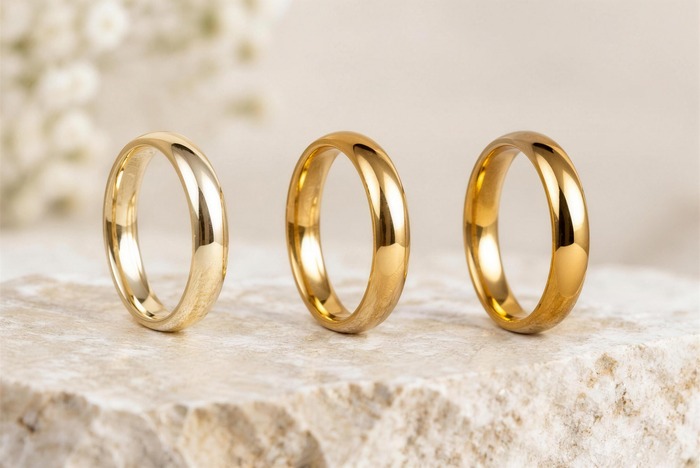
Offer a karat ladder. Show the same design in 10, 14 and 18 karat, each correctly stamped. The $164 metal gap on a simple band gives a hesitant customer a way to say yes.
Keep the customer’s gold in the store. Offer to remake old jewellery through a refiner that returns metal as karat stock. Toronto, for example, requires a licence and a register for anyone buying old gold for smelting, so check the local bylaw first.
Most of that metal passes through a single pair of hands at a bench. Part three looks at the Canadian jewellers who work alone, and why there are more of them than ever.
Next in the series: Part 3, The One Person Studio, publishes Wednesday 30 September.
Frequently asked questions
What is the gold price in Canada today?
On 25 September 2026, gold traded near US$4,298 an ounce, or about $6,061 Canadian. The Canadian dollar record was $7,344.62 on 28 January 2026.
Is recycled gold the same quality as new gold?
Yes. Once refined, recycled gold is chemically identical to newly mined gold, which is why the claim depends on documentation rather than testing the metal itself.
What karats can be sold as gold in Canada?
The Precious Metals Marking Act allows gold to be marked from 9 to 24 karat, with a registered trademark beside the quality mark.
What are the penalties for false environmental claims in Canada?
Since June 2024, a corporation can face the greater of $10 million, three times the benefit, or 3 per cent of worldwide revenue. Repeat violations raise the base amount to $15 million.
When did Canada ban gold exports?
An Order in Council banned gold exports on 31 October 1931, during the Depression, as Canada moved away from the gold standard.
Sources: CTV News Calgary · Exchange Rates, gold in CAD 2026 · Al Jazeera, January 2026 gold drop · CBC North, Skookum Jim nuggets · Royal Canadian Mint refinery · Bank of Canada Museum, gold standard · Asahi Refining Canada · World Gold Council, Q1 2025 · World Gold Council, Gold Demand Trends 2025 · CBC, gold and Canadian jewellers · Global Affairs Canada, February 2026 · CNBC, gold 25 September 2026 · Competition Bureau, environmental claims guidelines · MLT Aikins, Bill C-15 · Competition Bureau, precious metals marking · City of Toronto, precious metal buyers

Author: Canadian Jeweller Editorial Team
The editorial team of Canadian Jeweller Magazine, Canada’s jewellery industry publication since 1879. We report on retail strategy, diamonds and gemstones, watches, precious metals, technology, and the business of jewellery across Canada. Editorial inquiries: editor@canadianjeweller.com.


