







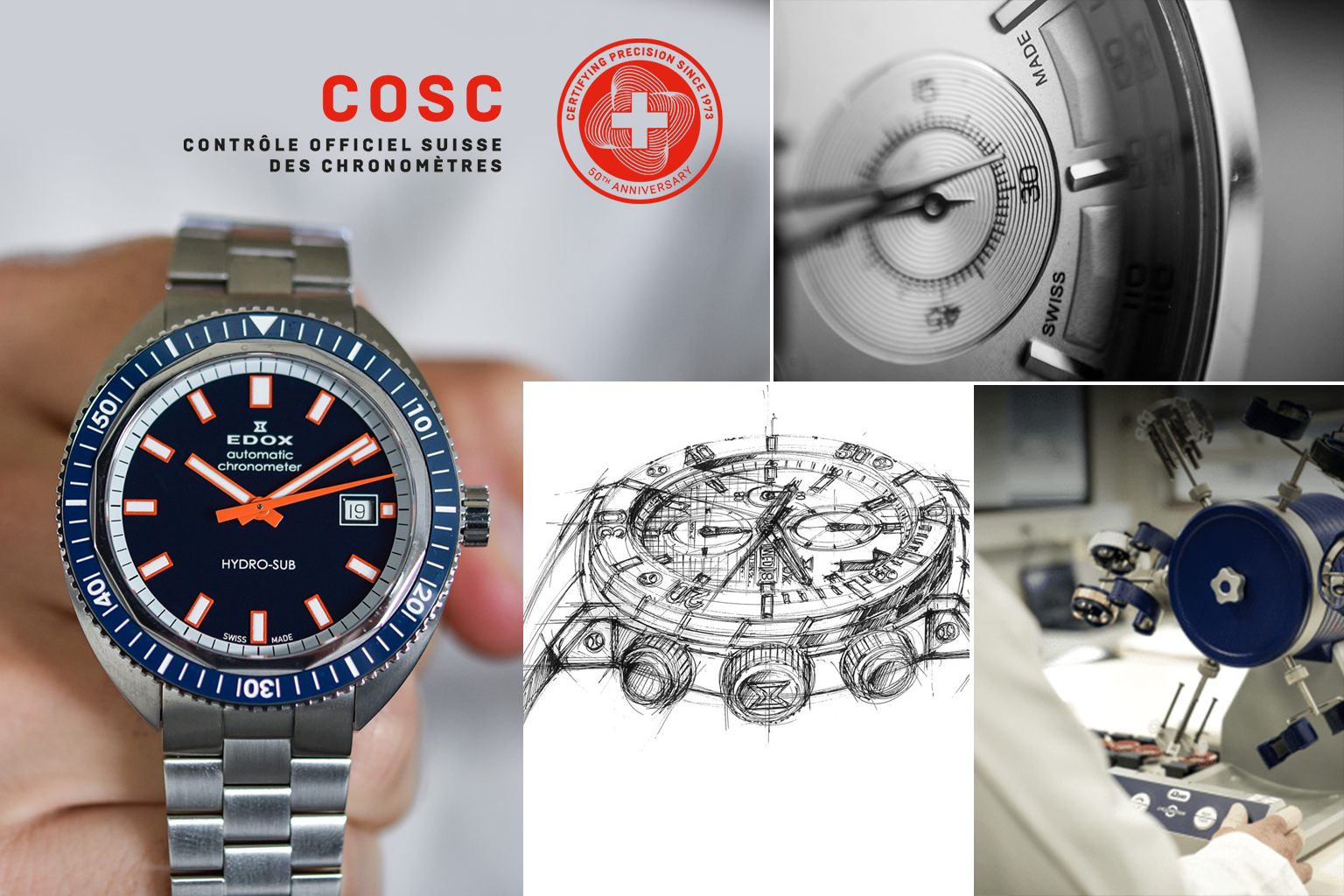
Most consumers walk into a Canadian jewellery shop with brand names in their head, not standards. Teach them one acronym and the sale shifts in your favour.
That acronym is COSC, the Controle Officiel Suisse des Chronometres. It is the Swiss federal institute that certifies a movement as a chronometer after fifteen days of laboratory testing in five positions and three temperatures, with a mechanical pass standard of -4 to +6 seconds per day. The number is verified by a federal body, not by the maker. There are very few sales claims in the watch trade as defensible as that one.
The Four Letters Most Clients Don’t Know — And Why That Is Your Opening
COSC certifies more than sixty brands a year, but the distribution is heavily skewed. Roughly 85% of annual certificates belong to three houses — Rolex, Omega and Breitling. Rolex alone accounts for close to half. Omega layers its METAS Master Chronometer programme on top. Breitling has historically run its full production through the institute, quartz included.
The other 15% is the part of the market most retailers under-sell. It includes Tudor, Tissot, Mido, TAG Heuer, Zenith, Chopard, Panerai, Ulysse Nardin, Longines, Ball, Bremont, Formex, Christopher Ward, Norqain, and independent Swiss houses like Edox. Movement specialists Sellita and ETA also submit calibres so smaller brands can sell chronometer-grade pieces.
For a Canadian jeweller, that uneven split is positioning fuel. The waitlists at the giants are someone else’s problem. The educated buyer who wants verified Swiss accuracy and a story nobody else at the cocktail party is wearing is yours to win.
The Harder Truth — Securing an Established Swiss Brand in 2026
Ask any jeweller who has tried to open an account with a tier-one Swiss house in the last few years. The doors are not just narrow — many are effectively closed.
Distribution across the established names has consolidated under a small number of luxury groups. Richemont, LVMH and Swatch Group control most of the heritage portfolios. Rolex, Patek Philippe and Audemars Piguet manage their networks directly and have been pulling back authorised dealer count rather than expanding it. The result is a market where waitlists are not a consumer inconvenience but a structural reality the retailer inherits from day one — assuming the retailer ever gets the contract.
Where new accounts do open, the requirements have hardened. Minimum opening orders in the six figures. Exclusive territory clauses. Annual purchase quotas, dedicated boutique build-outs, mandatory staff training rotations, deep marketing co-pay commitments. Add the cost of allocation pieces sitting in inventory and the math for an independent jeweller becomes punishing before the first sale.
This is the real opportunity behind the COSC conversation. A jeweller does not need to chase a closed door to put authenticated Swiss watchmaking on the wrist of a Canadian buyer. There are independent houses — still family-owned, still federally certified, still building in Switzerland — that are actively partnering with the right retail accounts. That is the door an independent jeweller can actually walk through.
Spotlight: Why Edox Belongs in Your Showcase
Of the independent Swiss names available to the Canadian trade, Edox earns particular attention. It is older than most of the brands a client will name from memory — founded 1884 in Biel/Bienne by Christian Ruefli-Flury, family-owned since 1983, and operating today out of Les Genevez in the Jura mountains.
The technical archive is the proof point. The 1961 Delphin introduced a double case-back and double-seal crown system. The 1965 Hydro-Sub reached 50 ATM water resistance via a tension-ring crown. The 1970 Geoscope was the first true world-time watch with more than fifty cities on the dial.
For the chronometer conversation, the modern Hydro-Sub Chronometer is the hero piece. It runs the Edox 806 automatic, built on a Sellita SW200 base and submitted to COSC. The 2025 Label Noir Edition keeps the line current for collectors.
What Edox gives a jeweller is a rare combination — heritage from the nineteenth century, true family independence, federal chronometer pedigree, working price points for a mid-tier Swiss programme, the scarcity of a genuine micro brand, and a partnership model that is realistically open to a Canadian independent. No allocation game. No five-year waitlist for a contract. A direct relationship with a Swiss house that still answers the phone.
A Five-Step Playbook for the Counter
Open with the standard, not the logo. The phrase “this movement spent fifteen days in a Swiss federal laboratory before it was even cased” outperforms any catalogue.
Anchor the accuracy figure. -4 to +6 seconds a day is concrete, repeatable, and easy for a client to share with a partner later.
Name the institute. Saying “Controle Officiel Suisse des Chronometres” once, in full, signals expertise without lecturing.
Frame the Big Three as context, not competition. The line that converts is “the houses your friends know hold most of these certificates — the one you are about to wear is the independent that has been quietly earning the same one since the nineteenth century.”
Hand the watch over. Weight, finish and the sweep of the seconds hand finish what your knowledge started.
In conclusion, COSC is a federal standard sitting unused on most Canadian sales floors. The giants already own the marketing. The opportunity for the independent retailer is to teach the standard, then place a credentialed independent like an Edox Hydro-Sub Chronometer on the client’s wrist. Heritage, ownership, federal certification, story — all in one handover.
That is how four letters close a sale.
Subscribe for more.
SOURCES
- Controle Officiel Suisse des Chronometres — official site
- COSC FAQ — testing protocol
- COSC overview — Wikipedia
- WatchGecko — Guide to COSC
- Hodinkee — Why I Miss the COSC Chronometer Data
- Omega — METAS Master Chronometer technical information
- Edox Swiss Watches — official site
- Ethos — Edox Hydro-Sub Chronometer Label Noir Edition
- Dialicious — Edox brand history and popular models
- Monochrome — Technical Perspective Guide to Certifications


