








Yes — selectively. An AI agent earns its keep doing the high-margin work a busy sales floor forces independents to abandon, and the stores that adopt early will build an advantage that is slow to copy. But an agent multiplies judgement rather than replacing it; aimed at a sloppy process without supervision, it scales the error, not the outcome. The defensible move is narrow: automate one workflow, let the agent draft, keep a person approving.
Picture the last hour before close. A repair needs a status call, three anniversary clients should have heard from you this week, an Instagram comment is going stale, a supplier email is unanswered, and a couple at the counter is deciding between two engagement rings. One owner, one finite evening. Something gives, and in most stores what gives is the follow-up — the single most profitable thing a jeweller does. An agent exists to make sure that work stops falling off the table. The technology is no longer the question. Timing is.
Agent, Not Chatbot
The distinction matters because it determines what you can actually offload. A chatbot answers when spoken to and stops. An agent is given a goal and a set of rules and then works the steps itself — reading from your systems, deciding within the limits you set, returning a finished result instead of a reply. In staffing terms, a chatbot is the colleague who responds when asked; an agent is the one who notices what needs doing and has it ready before you ask. The industry calls the underlying capability agentic AI: software that reasons, decides, and completes multi-step tasks on a business’s behalf.
The wider trade has already priced this in. Salesforce’s 2025 Connected Shoppers Report puts forty-three per cent of retailers in active pilots of autonomous AI and another fifty-three per cent evaluating it; a 2025 Deloitte study found seventy-seven per cent of retailers expect autonomous decision-making to be the defining competitive variable of the next five years. The serious conversation is no longer whether to adopt, but which workflow goes first.
Where Canada Actually Stands
The Canadian numbers describe an opening rather than a crowd. Statistics Canada reports that 12.2 per cent of Canadian firms used AI to produce goods or deliver services in 2025 — double the prior year — with another 14.5 per cent intending to within twelve months. Retail trails the national average: only sixteen per cent of retailers plan to adopt in the coming year, though that has more than doubled since 2024. Among firms already using AI, marketing automation climbed from 15.2 to 23.1 per cent.
The figure to dwell on is firm size. Microsoft reported in 2025 that seventy-one per cent of Canadian small and mid-sized businesses are using AI tools and roughly three in four intend to spend more, yet adoption among the very smallest firms — those under five people, which is most jewellery stores in this country — sits near thirty-nine per cent, well below the sixty-per-cent-plus of their larger peers. Translated for an independent: the segment you compete in is the least automated part of an already-cautious sector. That is leverage, not a warning. A caveat worth stating plainly, though — adoption data specific to the jewellery trade in Canada has not been published, so the figures here are national and cross-sector, and the jewellery-specific evidence that exists is largely international.
The Four Agents Worth Building
Four agents deserve a jeweller’s attention, and they reward adoption in a deliberate sequence — each one funding the next.
The storefront agent is the entry point. It lives on your website and messaging channels, fielding the after-hours questions that quietly decide whether an evening browser becomes a Tuesday appointment: turnaround times, custom capability, what is in stock. It qualifies and books while the store is dark, and it carries almost no downside, which is exactly why it should come first.
The clienteling agent is the one that moves the number. Working from your client records, it surfaces the anniversaries, repair pickups, and lapsed buyers a busy floor forgets, then drafts the outreach in your voice for your approval. This is where the margin lives. Personalised contact is the discipline that separates a jeweller with a book of returning clients from one forever chasing strangers, and the evidence is not subtle: international data shows eighty per cent of jewellery buyers are likelier to purchase from brands offering AI-driven personalisation, and recommendation engines already shape an estimated twenty-nine per cent of online jewellery sales. It is also the most jewellery-specific of the four, which is precisely why generic tools tend to disappoint here.
The marketing agent keeps the cadence most independents intend and rarely sustain: product copy, platform-native social posts, campaign email, review replies. The work seldom justifies a hire, and that is the point — an agent closes the gap between good intentions and a post that actually goes out on Thursday.
The operations agent is the deepest build and the last to attempt. Pointed at inventory and transaction data, it flags dead stock before it ties up capital, prepares reorders ahead of buying season, and drafts the appraisal and quoting paperwork that erodes a bench jeweller’s week. It demands clean data and genuine integration, so it rewards patience rather than enthusiasm.
The order is the strategy. Start at the storefront, climb toward operations, and let the returns from each rung pay for the next.
The Economics, and the Build-or-Buy Question
Three things are worth internalising before you sign anything. First, agents bill partly by use — each task spends several calls to the underlying model — so a bridal-season surge costs more than a quiet January, and the headline price is a floor rather than a ceiling; true cost of ownership lands near 1.5 times it once oversight and upkeep are counted. Second, a slice of interactions, call it five to fifteen per cent, will need a person by design — an agent that never escalates is one to distrust. Third, and most important, the technology is rarely the constraint; your data is. Aimed at a clean client list, an agent compounds relationships. Aimed at a messy one, it compounds the mess faster, and does it at speed.
Which leaves the decision that actually determines your spend: build it yourself or hire it out. The do-it-yourself path means subscribing to the tools and wiring them together on your own time — a capable owner can self-assemble the storefront and marketing agents from four layers: a business AI subscription for the reasoning (ChatGPT Team or Claude, roughly US$25–30 per user monthly), an orchestration tool to fire the triggers (Zapier, Make, or self-hosted n8n), a chatbot layer (Tidio, Manychat, Chatbase), and your CRM (Podium and Clientbook are jewellery-aware; HubSpot has a free tier). Hiring it out means paying an agency or a managed platform to build, integrate, and maintain it. The cost by agent splits roughly as follows, in US dollars, since that is how most platforms bill.
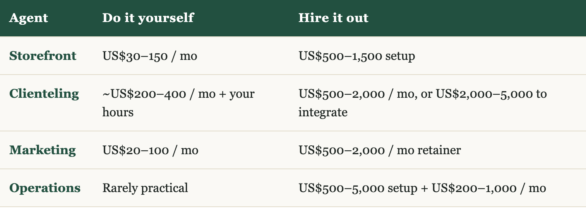
The trade is plain: doing it yourself spends dollars sparingly and time heavily; hiring inverts that and adds a dependency. The comparison below maps where each route wins.
A reasonable rule for most independents: self-build the storefront and marketing agents, where the stakes are low and the setup is light, and hire — or buy a managed platform — for clienteling and operations, where the integration is deep and a mistimed client message costs a relationship. This is the case for a managed platform built for the trade rather than a generic one bent to fit it. RGMClix by Canadian Jeweller Magazine is built for exactly that: it folds the majority of these tools — storefront, clienteling, marketing, and CRM — into a single platform tailored to independent jewellers, so you skip the plumbing without inheriting software designed for someone else’s business. Explore it at gemify.canadianjeweller.com.
Where It Goes Wrong
The failure modes are predictable, which makes them avoidable. The first is tone. Luxury clienteling runs on a warmth software cannot fake, and the client spending five figures on a ring wants to feel known, not processed; an unsupervised agent will send a tone-deaf note as efficiently as a perfect one. The second is data stewardship — client records carry obligations under Canadian privacy law, and any tool that touches them belongs to a deliberate choice, not a free trial. Both point to the same operating model: the agent drafts, a person approves, every time. That single rule converts most of the risk into routine.
What to Do Next
Resist the urge to automate the whole store at once. Choose one workflow, prove it, expand. For nearly every jeweller that first workflow is clienteling, because the return is immediate, the result is measurable in booked appointments and reactivated clients, and it targets the exact task a busy floor forces you to drop. Run it for sixty days with the agent drafting and you approving, count what it brings back, and let the evidence choose the second.
So — do jewellers need to get into AI agents? Not for fashion. Because the work an agent does is work most stores are already losing, and the ones who move first will spend the next five years compounding relationships their competitors never found time to build. In a trade that has run since 1879 on knowing your client by name, that is not a marginal edge. It is the entire contest.


