The Lab Grown Diamond Debate Is Now a Fight Over One Word
Three industry bodies issued three instructions for describing one lab grown stone this fall. None is Canadian law. The positions, the numbers and a Monday file.
The lab grown diamond debate became a fight over one word this fall. In about six weeks, three industry bodies gave jewellers three different instructions for describing the same stone, and none of those instructions is Canadian law.
The sequence started on September 7. After its centenary congress closed in Vicenza, Italy, the board of the World Jewellery Confederation (CIBJO) approved a revision of its Blue Books. Under that revision, synthetic becomes the sole descriptor for a created stone that matches its natural counterpart.
Fifteen days later, the Natural Diamond Council removed the word natural from its own name. It relaunched as The Diamond Collective on September 22 under chief executive Amber Pepper. “Diamonds are the original. They do not need a qualifier,” she wrote in the letter that opens the strategy.
Then, on October 20, the Diamond Producers Council answered for the growers. The group advised jewellers to reject the CIBJO wording. Its notice also reserves the right to pursue legal remedies against anyone who uses synthetic in a way that misleads a buyer.
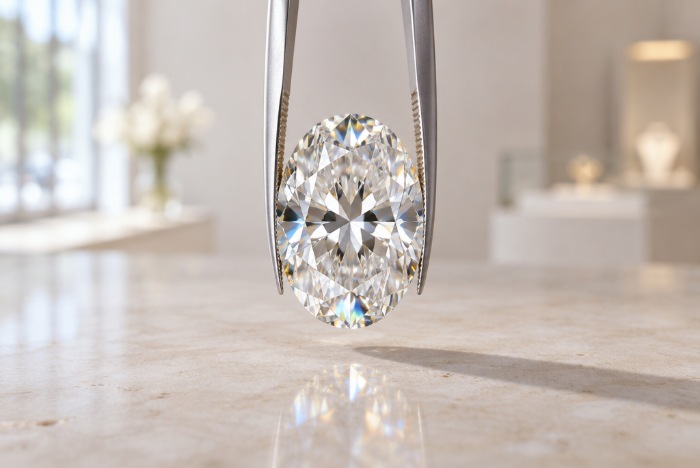
Picture one two carat oval in a showcase. Under the CIBJO text, its tag reads synthetic diamond. Under American guidance, it reads laboratory grown diamond. And under the Collective’s logic, the mined stone beside it is simply a diamond.
What is the lab grown diamond debate about in 2026?
The argument is about who owns the plain word diamond. The Collective says the mined stone is the original, so it needs no adjective. Growers reply that their product is the same crystal with a different origin. Both camps still accept that the buyer must be told where a stone came from.
The Collective’s plan also goes well beyond a name. Its strategy document sets out three priorities, which it calls unite, protect and inspire. One programme is a legally protected Trustmark for natural diamonds, piloted with leading retailers before a wider rollout. Another is a Diamond Desire Index, built with research firm Basis, which sets its first baseline in the fourth quarter of 2026.
| Body | Position on the word | Date | Force in a Canadian store |
|---|---|---|---|
| CIBJO | Synthetic as the sole descriptor in its Blue Books | September 7, 2026 | Trade standard. CIBJO says national law takes precedence |
| The Diamond Collective | Diamond needs no qualifier. Created stones are synthetic diamonds | September 22, 2026 | Marketing body. No regulatory power |
| Diamond Producers Council | Use lab grown. Warns of legal action over misleading use of synthetic | October 20, 2026 | Advocacy body. Its notice claims reach beyond the United States |
| US Federal Trade Commission | Accepts laboratory grown and laboratory created | 2018 | American guidance only |
| Canada | No diamond naming rule located | Not applicable | Competition Act rules on misleading representations apply |
Who decides what a jeweller can call a lab grown diamond in Canada?
None of the three bodies does. CIBJO writes trade standards, and it acknowledged in September that national law takes precedence. The Collective is a marketing organisation funded by the industry. The Diamond Producers Council is an advocacy group for growers.
We could not locate a Canadian statute that names the words a jeweller must use for a lab grown diamond. The Competition Act still applies to every tag and advertisement, because it prohibits false or misleading representations. So the practical test in a Canadian store is whether the buyer understood what they bought.
The American position is also worth knowing, because many Canadian suppliers sell into both markets. In 2018, the US Federal Trade Commission revised its guides for the trade. It accepted laboratory grown and laboratory created as descriptors. It also warned against using synthetic to suggest that a competitor’s lab grown stone is not a diamond. This is general information, not legal advice.
What do the sales numbers say about natural and lab grown diamonds?
Canadian data on lab grown market share is not available. No public source tracks it, so the closest benchmark is American.
| US measure | Figure | Source |
|---|---|---|
| New engagement rings with a lab grown centre stone, January to June 2026 | 51 per cent | BriteCo appraisal data |
| The same measure in 2019 | 5.9 per cent | BriteCo appraisal data |
| Engagement rings with a lab grown centre stone, couples married in 2025 | 61 per cent | The Knot, 10,474 couples |
| Median sale price, natural diamond engagement ring, 2025 | US$12,961 | BriteCo appraisal data |
| Median sale price, lab grown diamond engagement ring, 2025 | US$4,557 | BriteCo appraisal data |
| Canadian equivalent for any line above | Not available | No public source |
Take ten bridal sales at the BriteCo medians. Ten natural rings bring in US$129,610, and ten lab grown rings bring in US$45,570. Analyst Edahn Golan of Tenoris has estimated retail gross margins above 75 per cent on lab grown, against roughly 35 per cent on natural. At those estimates, the natural ten return about US$45,000 in gross profit. The lab grown ten return about US$34,000.
That arithmetic explains why so many showcases now hold both. Lab grown wins the unit count in the wedding surveys, while natural still carries the larger ticket. As a result, a store that tracks the two lines separately can see which one earns more in each price band.
Where does Canada fit in The Diamond Collective strategy?
The strategy document names its priority markets. Consumer protection work targets the United States, the European Union, France and India. The Desire Index covers the United States, India and China. Canada appears in neither list.
Yet Canada is a producer nation, and the document promises deeper partnerships with producer nations. The timing matters here. Rio Tinto’s Diavik mine delivered its final production in March. Ekati entered receivership on July 14, according to the Government of the Northwest Territories. Our earlier report on Canadian diamond mines explains why stones with a Canadian address are now a finite supply.
The Collective also plans to make origin and provenance a selling point across retail. For that reason, every documented Canadian stone already in a vault gains a story backed by shrinking supply. Lab grown suppliers have a parallel opening, because a named growing location answers the same origin question.
What should go in the Monday morning file?
- Audit the word. Check every tag, website listing, invoice and appraisal. Choose one origin term, place it directly beside the word diamond, and use it everywhere.
- Brief the floor. Staff should describe origin and then stop. A contrast between real and fake is the wording that drew a US advertising ruling in 2021.
- Collect the paperwork. Ask suppliers now for origin documents on Canadian stones, because closed mines issue no new ones.
- Split the ledger. Record natural and lab grown sales as separate lines, then compare gross profit dollars by price band each month.
- Ask about the Trustmark. The pilot starts with leading retailers. So far, the Collective has published no date or Canadian terms for wider access.
Frequently asked questions
Is synthetic diamond the required term in Canada?
No. The CIBJO Blue Books are trade standards, and CIBJO says national law takes precedence. We located no Canadian rule that names a required term. The Competition Act prohibits misleading representations in any wording.
What is The Diamond Collective?
It is the new public name of the Natural Diamond Council, announced on September 22, 2026. The Natural Diamond Council remains the legal entity. Its stated goal is more people choosing natural diamonds, more often.
Can a Canadian jeweller face legal action for saying synthetic?
The Diamond Producers Council has reserved the right to act against misleading use of the word, including outside the United States. That notice is a statement of intent from an advocacy group. It is not a court ruling. This is general information, not legal advice.
What share of engagement rings are lab grown?
In the United States, BriteCo appraisal data shows 51 per cent for the first half of 2026. The Knot reports 61 per cent among couples married in 2025. Canadian figures are not available.
When can independent retailers use the natural diamond Trustmark?
The Diamond Collective says the Trustmark will be piloted with leading retailers ahead of a broader rollout. It has not published a date, a cost or Canadian details.
Sources: The Diamond Collective strategy document and September 22, 2026 release; CIBJO; Diamond Producers Council; US Federal Trade Commission; BBB National Programs; BriteCo; The Knot Worldwide; Government of the Northwest Territories.

Author: Olivier Fel.
Olivier Felicio is the founder and publisher of Canadian Jeweller Magazine, Canada's jewellery business publication since 1879. He writes on retail strategy, market data, trade policy and the commercial side of the Canadian jewellery and watch trade, and hosts Time and Shine, Canada's jewellery buying event. Contact: olivier@canadianjeweller.com.