







147 Years of Canadian Jewellery Design · Part 4 of 5
- Part 1: The Engraved Cuff
- Part 2: Metal With a Past
- Part 3: The One Person Studio
- Part 4: Stones With a Canadian Address (you are here)
- Part 5: The Nation’s Jewel (publishes Friday 2 October)
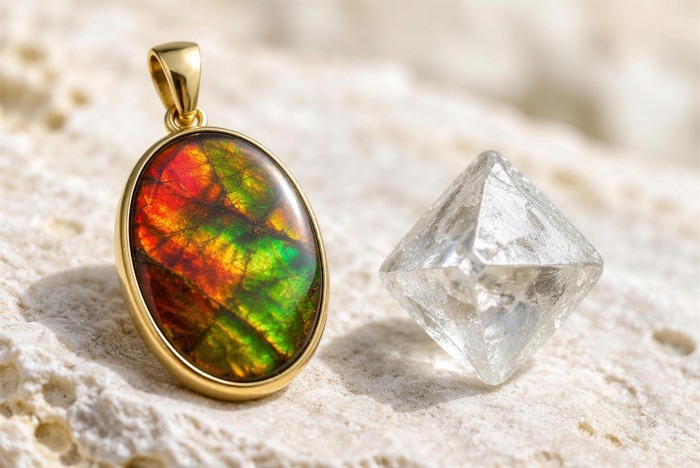
Canada has one producing diamond mine left. Diavik ended production on 26 March 2026, Ekati went into receivership on 14 July 2026, and Gahcho Kué is expected to close in 2028. For jewellers, stones with documented Canadian origin have become a finite supply, while Alberta’s ammolite has new Indigenous owners.
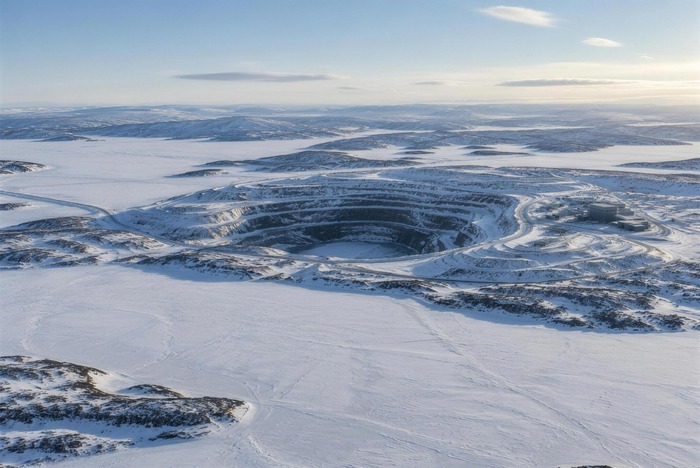
By 10 July 2026, the sale process for Ekati had run its course. It had reached 140 parties. Of those, three signed confidentiality agreements. In the end, nobody bid. Four days later, a receiver was appointed for Canada’s first diamond mine, and the Government of the Northwest Territories took responsibility for the site.
Part three of this series followed the people at the bench. This part follows what they set: the stones that carry a Canadian address. However, one of those stories is ending, while the other has just changed hands.
What happened to Canada’s diamond mines?
- April 1990. Geologist Chuck Fipke finds an indicator mineral at Point Lake. The find is then announced in 1991.
- 14 October 1998. Ekati opens as Canada’s first diamond mine.
- 1999. The Northwest Territories adopts a diamond policy framework. Certified stones carry a microscopic laser engraved polar bear.
- January 2003. Diavik begins production beneath Lac de Gras.
- 2 June 2003. BHP Billiton launches CanadaMark, a chain of custody program for Ekati diamonds from rough to polished.
- 2017 to 2018. Canadian production peaks at 23.2 million carats worth $2.7 billion.
- 18 July 2022. The territorial government relaunches the Polar Bear Diamond, limited to 16,000 stones to match Canada’s polar bear population.
- 2024. Canada produces 13.3 million carats worth $1.47 billion and ranks fourth in the world by both volume and value.
- 8 May 2025. De Beers announces it will close Lightbox, its laboratory grown brand. Lab grown wholesale prices have fallen about 90 per cent since 2018.
- 26 March 2026. Diavik produces its last diamonds after 23 years and more than 150 million carats.
- 1 May 2026. Ekati’s operator receives creditor protection. Its owner, Burgundy Diamond Mines, cites the effect of American tariffs.
- 14 July 2026. Ekati goes into receivership.
At Diavik’s closing, Rio Tinto’s Sophie Bergeron remembered the start: “Forty years ago there were very few people who believed there were diamonds in Canada.”
| Mine | Opened | Status, September 2026 |
|---|---|---|
| Ekati, NWT | 1998 | In receivership since 14 July 2026, being shut down |
| Diavik, NWT | 2003 | Production ended 26 March 2026 |
| Gahcho Kué, NWT | 2016 | Producing; closure expected in 2028 |
| Victor, Ontario | 2008 | Closed in 2019 |
| Renard, Quebec | 2016 | Not producing |
What are Canadian diamonds worth now?
Gahcho Kué offers the clearest Canadian price signal. Mountain Province Diamonds, which owns 49 per cent, reported an average of $48 a carat in the first half of 2026, against $97 a year earlier. In other words, the price fell by about half. The company’s quarterly report now carries going concern language.
Meanwhile, Canada publishes no data on laboratory grown diamonds’ share of retail sales. Natural Resources Canada has not yet released its 2025 production figures, and 2026 will fall sharply with two of three mines gone. Nevertheless, the direction is plain. Natural Canadian goods are becoming an end of supply story, while lab grown stones trade as a commodity.
What is ammolite, and who mines it?
Ammolite is the iridescent shell of two ammonite species, Placenticeras meeki and Placenticeras intercalare, from Alberta’s Bearpaw Formation. It formed roughly 70 to 75 million years ago. The Blackfoot knew it long before the trade did, calling it iniskim, a buffalo stone carried for luck.
- 1908. Geological Survey scientists describe the iridescent shell.
- 1962. Cut ammolite is first shown in jewellery at Nanton, Alberta.
- 1967. Calgary’s Marcel Charbonneau makes doublets and names the stone.
- 1981. The CIBJO Coloured Stones Commission recognises it as a gemstone.
- 30 April 2007. Lethbridge names ammolite its official gemstone.
- April 2022. Alberta adopts ammolite as its official gemstone, the province’s twelfth emblem.
- November 2024. Buffalo Rock Mining, owned by Tracy and Beth Day Chief of the Kainai Nation, buys Korite out of receivership.
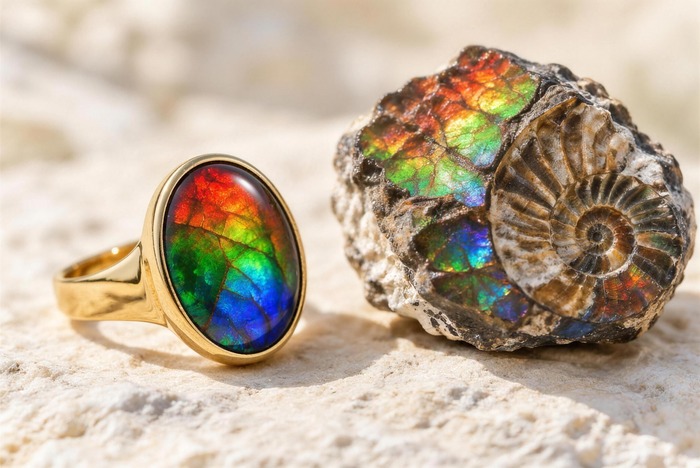
Today, mining takes place on the Blood Reserve along the St. Mary River, with Korite on one bank and Buffalo Rock on the other. According to Korite, the top AAA and AA grades make up only 3 to 5 per cent of its annual output. Moreover, the colour layer is thin, so most ammolite is sold as assembled stones. A natural stone rates about 3.5 on the hardness scale and suits pendants and earrings. By contrast, a triplet with a quartz cap reaches above 7, which makes it the right choice for rings.
In addition, Canada has other stones with a story. British Columbia made nephrite jade its official gemstone in 1968, and in 2002 the Aqpik brothers found sapphires near Kimmirut on Baffin Island. Those sapphires return in the final part of this series.
What should the trade do about Canadian stones now?
Treat documented origin as its own category. CanadaMark, Polar Bear and territorial certificates now describe a closing supply. Keep them in a separate showcase and never discount them alongside commodity goods.
Sell rarity, not price. Mountain Province’s figures and the collapse in lab grown wholesale prices tell the same story from opposite ends. A named Arctic origin is the one thing a laboratory cannot copy.
Sell ammolite by grade and construction. Train staff to explain doublets and triplets, and to recommend triplets for rings. Then tell the Kainai ownership story, which few customers have heard.
Finally, Canadian stones have often ended up in the country’s most formal gifts. The last part of this series follows the jewels Canada gives when it wants to say something important.
Next in the series: Part 5, The Nation’s Jewel, publishes Friday 2 October.
Frequently asked questions
Are there any diamond mines still operating in Canada?
As of September 2026, Gahcho Kué in the Northwest Territories is the only producing diamond mine. It is expected to close in 2028.
Why did the Ekati diamond mine close?
Its operator sought creditor protection on 1 May 2026, citing American tariffs, and a sale process drew no bids. A receiver was appointed on 14 July 2026.
When did ammolite become Alberta’s official gemstone?
Alberta adopted ammolite as its official gemstone in April 2022. Lethbridge had named it the city’s gemstone in 2007.
Can ammolite be worn in a ring?
Natural ammolite is soft, at about 3.5 on the hardness scale. For rings, a triplet with a quartz cap is more durable.
What is a CanadaMark diamond?
CanadaMark is a chain of custody program launched in 2003 for diamonds from Ekati, tracking each stone from rough to polished.
Sources: Cabin Radio, Ekati sale process · BNN Bloomberg, Ekati creditor protection · Rio Tinto, Diavik final production · Cabin Radio, Gahcho Kué closure · Mountain Province, Q2 2026 · Natural Resources Canada, diamond facts · GIA, Diavik · NWT Timeline, diamonds · IDEX, CanadaMark launch · GNWT, Polar Bear Diamond · De Beers Group, Lightbox · Galt Museum, ammolite · GIA, ammolite 2001 · Government of Alberta, emblems · Korite, Buffalo Rock acquisition · Korite, ammolite grades · BC Government, jade · ScienceDaily, Beluga sapphire

Author: Canadian Jeweller Editorial Team
The editorial team of Canadian Jeweller Magazine, Canada’s jewellery industry publication since 1879. We report on retail strategy, diamonds and gemstones, watches, precious metals, technology, and the business of jewellery across Canada. Editorial inquiries: editor@canadianjeweller.com.


