

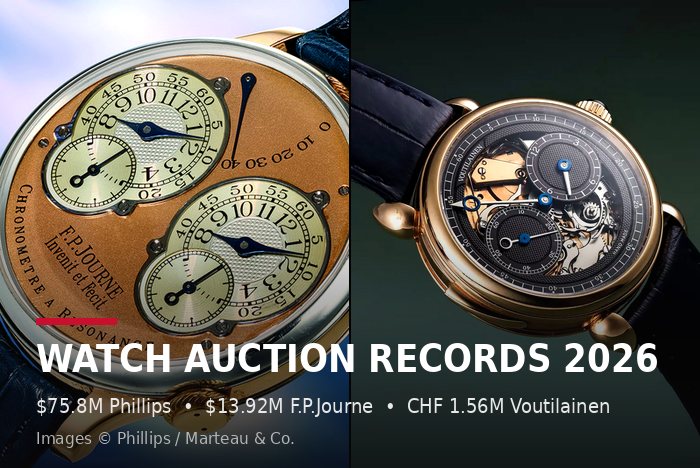
The gavel came down in New York after nearly nine minutes of bidding, and three records fell with it. The F.P.Journe Chronomètre à Résonance “Souscription, No. 007” sold for $13.92 million at Phillips’ New York Watch Auction: XIV — the most expensive Journe ever, the most expensive watch by any independent watchmaker, and the most expensive 21st-century watch sold at commercial auction.
How big was the Phillips New York Watch Auction: XIV?
The two-day sale, held in association with Bacs & Russo in June 2026, totalled $75.8 million — the highest-grossing watch auction in United States history, comfortably clearing the $43.5 million record Phillips itself set only last December. Sixteen timepieces sold for more than $1 million each, among them a possibly unique Patek Philippe ref. 5004G-020 made for Eric Clapton, which raced past its $700,000 low estimate to a reference-record $5.2 million.
Why is F.P.Journe dominating auctions?
The concentration is remarkable: seventeen Journe lots — about 10% of the 158-lot catalogue — generated $29.4 million, nearly 40% of the entire sale. Four Journes beyond the Résonance hammered between $1.9 million and $5 million. Early souscription pieces sit at the centre of the frenzy because they combine tiny supply, a living legend’s signature, and provable firsts — the same trinity that built vintage Patek values a generation ago, compressed into a maker whose subscribers are still alive to tell the story.
What records did Marteau & Co. set?
The newer house made its own history at The Heat Wave auction in June. Kari Voutilainen’s Pièce Unique Regulator Decimal Repeater achieved CHF 1.56 million — about US$1.9 million, a record for the Finnish master. And Qian GuoBiao’s Facing the Sky 2.0 Workshop Prototype No. 00 brought roughly CHF 102,000, the highest price ever paid for a Chinese independent watch — a market first that quietly redraws the map of collectable watchmaking.
Marteau & Co.’s structural experiment deserves its own line: the house pays a 3% maker’s fee to the original watchmaker on every lot sold. In an industry where artisans have watched their early work resell for multiples of the original price without seeing a franc of it, that resale royalty is a genuine break with auction convention.
What does the auction boom mean for jewellers and watch retailers?
Auction results are the most public price discovery the watch business has, and they move behaviour on the retail floor within weeks. Record independent prices pull collector attention — and budgets — toward the category, which lifts demand for every hand-finished brand a retailer carries, not only the unobtainable names. They also reprice estates: pieces sitting in Canadian safety deposit boxes are worth more than their owners think, which makes trade-in and estate-buying programmes more productive right now than they have been in years.
No Canadian auction results figure in these totals — the records were set in New York and by a Geneva-based online sale — and comparable Canadian auction data for high-end watches remains limited. But Canadian collectors buy in these rooms, and Canadian retailers appraise against these numbers.
What are the risks?
Concentration is the caution flag. When one maker’s lots carry 40% of a record sale, the market’s health is partly a bet on one name’s continued mythology. Souscription-level results also tempt sellers to overprice ordinary references — most watches are not No. 007, and the gap between trophy lots and the merely excellent is widening, not narrowing.
What should readers do next?
Retailers should refresh estate-buying price guidance against the June results, and appraisers should note the new independent benchmarks — Journe, Voutilainen, and now Qian GuoBiao — before the fall auction season resets them again. Canadian Jeweller will track whether the records survive November.
FAQ:
Q: What is the most expensive F.P.Journe ever sold?
A: The Chronomètre à Résonance “Souscription, No. 007,” which sold for $13.92 million at Phillips’ New York Watch Auction: XIV in June 2026 — also the record for any watch by an independent watchmaker.
Q: What was the total for Phillips’ New York Watch Auction: XIV?
A: $75.8 million, the highest-grossing watch auction in US history, with 16 timepieces selling above $1 million each.
Q: What records did Marteau & Co. set at The Heat Wave auction?
A: A Kari Voutilainen record — CHF 1.56 million for the Pièce Unique Regulator Decimal Repeater — and the highest price ever paid for a Chinese independent watch, about CHF 102,000 for Qian GuoBiao’s Facing the Sky 2.0 Workshop Prototype No. 00.
Q: What is Marteau & Co.’s maker’s fee?
A: A 3% fee on each sale paid to the original watchmaker — a resale royalty that gives living artisans a share of their work’s secondary-market appreciation.
Q: Why do auction records matter to watch retailers?
A: They reset price discovery for appraisals, estate buying and trade-ins, and they signal which categories — currently independent watchmaking — are drawing collector budgets.

Author: Canadian Jeweller Editorial Team
The editorial team of Canadian Jeweller Magazine, Canada’s jewellery industry publication since 1879. We report on retail strategy, diamonds and gemstones, watches, precious metals, technology, and the business of jewellery across Canada. Editorial inquiries: editor@canadianjeweller.com.


