







India’s largest jewellery customer is now the United Arab Emirates, after American buying collapsed 44.92 per cent in a single year. That scramble reached the UAE, Australia, Oman and Britain. Canada it skipped, and the reason is a tariff decision Ottawa took in 2015 that only the Canada India jewellery trade agreement now in negotiation can undo.
Four point one five billion US dollars walked out of the Indian jewellery trade in twelve months. American purchases fell from US$9.24 billion to US$5.09 billion across FY 2025-26. Dubai picked up the crown at US$8.70 billion, up 10.52 per cent. Ten per cent growth, against a 45 per cent collapse. First time in the modern history of the business that India’s biggest customer files its paperwork in the Gulf.
Now watch what India did about it. This part matters more than the loss.
What did India build to replace the American market?
Trade agreements, at speed. Oman first, in force from 1 June 2026. Britain next, from 15 July, under CETA. Deals with the UAE and Australia were already running, and agreements with the European Union and New Zealand sit finished, awaiting operationalisation.
Here is the number that should stop a Canadian buyer mid page. India lost close to half of its largest export market and still finished the year at US$27.72 billion, down only 3.32 per cent overall. Australia grew 38.33 per cent. That is what a diversification strategy looks like when it works, and it took roughly four years of trade negotiation to build.
Factory output moved with it. Silver jewellery exports jumped 52.21 per cent to US$1.47 billion. Platinum jewellery rose 39.32 per cent to US$254.60 million. Plain gold jewellery slid 7.42 per cent to US$4.84 billion, and cut and polished diamonds gave up 8.52 per cent.
| India, FY 2025-26 | Value | Change |
|---|---|---|
| Total gem and jewellery exports | US$27.72 billion | Down 3.32 per cent |
| To the UAE | US$8.70 billion | Up 10.52 per cent |
| To the United States | US$5.09 billion | Down 44.92 per cent |
| To Australia | Not disclosed separately | Up 38.33 per cent |
| Silver jewellery, all markets | US$1.47 billion | Up 52.21 per cent |
| Platinum jewellery, all markets | US$254.60 million | Up 39.32 per cent |
Silver deserves a second look from anyone writing a Canadian buying plan. A hard second look. It grew by half in a year, it is the category where Canadian unit counts have held up while gold pricing walks customers down the case, and it is now sitting in Indian factories looking for somewhere to go.
What did the scramble look like on the floor at IIJS Bharat Premiere?
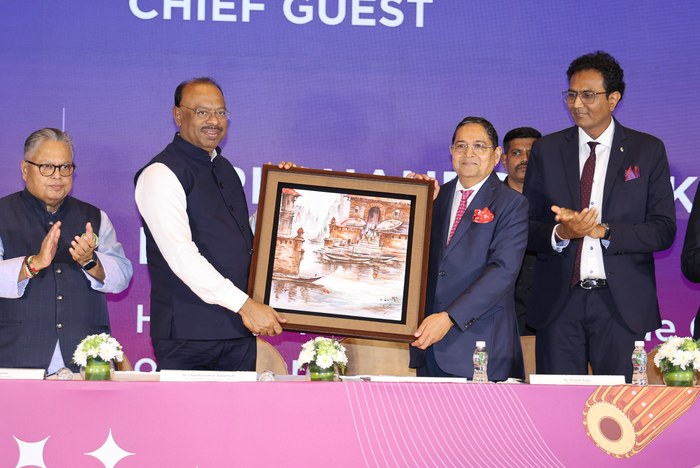
Enormous. Its 42nd edition ran at the Jio World Convention Centre in Bandra Kurla Complex from 5 to 9 August 2026, and at the Bombay Exhibition Centre at NESCO, Goregaon, from 6 to 10 August. Maharashtra Revenue Minister Chandrashekhar Bawankule opened the first venue and Union Minister Chirag Paswan opened the second.
Over 135,000 square metres, more than 2,100 exhibitors across 3,600 stalls, projected attendance above 50,000, and better than 2,700 international buyers drawn from over 80 countries. Scale on that order is hard to picture from Toronto. Alongside it, the India Gem and Jewellery Machinery Expo filled 348 stalls with 249 makers of casting, finishing, automation and precision tooling. Couture sat with The Select Club, jewellery technology with JewelStart Demo Day, and the 20 Under 40 cohort put the trade’s next generation on a stage. Twenty five years of IIJS, marked in the same week.
That is the second largest business to business gem and jewellery exhibition on the planet. Canadian buying offices barely register in the attendance. GJEPC publishes no country by country breakdown of who those 2,700 buyers were, so nobody can put a figure on how few Canadians walked it, which is its own kind of answer.
Why is Canada missing from a list that includes Oman?
Because Canada made Indian jewellery expensive, then stopped thinking about it. That decision is eleven years old.
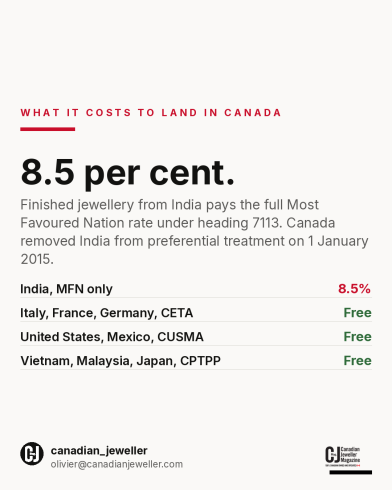
On 1 January 2015, Canada removed India from the General Preferential Tariff in a withdrawal order that graduated 72 countries and territories out of the programme at once. Indian finished jewellery has paid the full Most Favoured Nation rate ever since.
| Origin | Instrument | Duty on finished jewellery, heading 7113 | Cost on a C$50,000 order |
|---|---|---|---|
| India | MFN only, preference withdrawn 2015 | 8.5 per cent | C$4,250 |
| Italy, Germany, France | CETA | Free | Nil |
| United States, Mexico | CUSMA | Free | Nil |
| Vietnam, Malaysia, Singapore, Japan | CPTPP | Free | Nil |
| Least developed countries | LDCT | Free | Nil |
Run C$4,250 through a real store. On a conventional keystone it arrives as roughly C$8,500 of shelf price for the customer to carry, or the same amount of margin carried by the retailer instead. Two or three orders a year and it is a part time salary. Substitute an actual order value and an actual markup. Numbers move. The shape of it holds.
Loose polished diamonds under 7102.39, meanwhile, enter free from every origin. Which produces the pattern running quietly through Canadian inventory: Indian stones, other people’s mountings.
Canada bought US$306.05 million of Chapter 71 goods from India during 2025. Roughly US$165.10 million of that was articles of jewellery and precious metal parts, US$101.86 million diamonds, US$16.91 million precious metal waste and scrap. Against a US$27.72 billion export book, Canada is a rounding error at a shade over one per cent.
Against a hole of US$4.15 billion, a rounding error starts to look like a market worth courting.
Where does the Canada India jewellery trade agreement stand?
Further along than most of the trade realises. Prime Ministers Mark Carney and Narendra Modi launched negotiations on 23 November 2025. Canada filed its notice of intent the following day and consulted stakeholders from 13 December 2025 through to 27 January 2026. Round two ran at Vanijya Bhawan in New Delhi from 4 to 8 May 2026, and round three followed in Ottawa from 6 to 10 July, covering market access for goods, rules of origin and services across a relationship already carrying close to C$10 billion in annual two way trade.
Both governments have put a 2026 conclusion on the record, after which come ministerial engagement, legal vetting and ratification in two parliaments.
That last stretch is where trade optimism traditionally goes to die, so nobody should build a purchase plan on it. Direction of travel still counts for something.
Who in Canada actually loses when that duty disappears?
Domestic wholesalers. Nobody has said a word about it.
For eleven years Canadian wholesalers and manufacturers have competed against direct Indian shipment while holding eight and a half points of protection nobody in the building lobbied for and nobody would defend out loud. It has been quietly propping up a slice of domestic margin the whole time. Take it away and the ground shifts to what a Canadian supplier genuinely does better: memo, terms, a reorder that lands inside a week rather than inside a quarter, repair and remake, sizing on short notice, and a telephone answered in the same time zone by somebody who knows the account.
Suppliers leaning on price feel that first. Fair warning, and it is coming from a publication that would rather say it early than write the obituary later.
Read the same news backwards and it cuts the other way. India dropped most of its own jewellery import barriers for FTA partners in the deals it signed with the UAE and Australia. Indian appetite for Canadian origin diamonds and finished Canadian design is untested, which is a different thing from absent, and a CEPA opens that door from both sides.
One gap belongs on the page rather than under it. Statistics Canada publishes no series separating finished jewellery imports from loose goods at a level that would show what share of Canadian store inventory originates in India, and no public count exists of Canadian buyers attending IIJS. Tariff arithmetic above is solid. Market share arithmetic behind it does not exist in Canadian data, and any figure claiming otherwise is guessing.
What is the rough diamond rule change, and does it reach Canada?
Introduced in the Lok Sabha on 4 August 2026, the Taxation and Other Laws (Amendment) Bill, 2026 exempts income earned by foreign miners, sightholders, brokers, aggregators and auction houses on rough diamond sales conducted inside India’s notified special zones. Fifteen years of it, running 1 October 2026 to 31 March 2041.
GJEPC chairman Kirit Bhansali put the ambition plainly at the show. For decades India cut and polished the world’s diamonds without ever trading them, and the bill exists to change exactly that. Miners bring rough directly to India. Manufacturers source at origin. A trading layer that has lived in Antwerp, Dubai and Tel Aviv acquires a fourth address.
For a Canadian retailer the consequence sits upstream and moves slowly. A deeper Indian trading counter points toward more competitive polished pricing over a multi year horizon, and Canadian rough, which already travels through Indian factories, gains another route to market. Nobody should reprice a case over it. Anyone signing a long term supply arrangement, on the other hand, should know it is coming and should think hard about the length of the commitment.
The file for Monday
Pull one Indian invoice from the last twelve months of buying and find the duty line, because annualised, that figure is exactly what a concluded agreement is worth to the business and exactly the figure to put in front of Ottawa the next time the government consults the trade. No estimate required.
Price a silver programme from an Indian supplier twice, once at the current rate and once at zero, because Indian silver capacity grew by half in a year and is hunting for homes. Knowing both landed costs in advance means moving in the week terms change, rather than the quarter after, or the quarter after that.
For suppliers, write down what the business sells that is not price. A short list means a short runway.
Canadian buyers who want Indian manufacturers in front of them without a flight to Mumbai have a shorter route, because Time and Shine, Canada’s jewellery buying event, puts that same conversation across a booth counter and settles it in Canadian dollars.
Frequently asked questions
Does Canada’s jewellery duty apply to loose diamonds bought from India?
No. Polished diamonds under tariff item 7102.39 enter Canada free from all origins. Duty of 8.5 per cent applies to finished articles under heading 7113, which is why Canadian assortments lean toward Indian stones and away from Indian mountings.
If the Canada India jewellery trade agreement concludes in 2026, when would a Canadian retailer see lower landed costs?
Not immediately. Conclusion of negotiation is followed by legal vetting, signature and ratification in both countries, and tariff elimination in agreements of this kind is usually phased across several years by product line.
Which Indian categories are growing fast enough to matter to a Canadian buying plan?
Silver jewellery, up 52.21 per cent to US$1.47 billion in FY 2025-26, and platinum jewellery, up 39.32 per cent to US$254.60 million. Both climbed while plain gold and polished diamonds contracted, which tells you where Indian factory capacity has been redirected.
Sources: Canada Border Services Agency Customs Tariff 2026, Chapter 71; General Preferential Tariff Withdrawal Order, SOR/2013-161, Canada Gazette Part II; Global Affairs Canada, Canada India CEPA negotiations; Press Information Bureau, Government of India; PRS Legislative Research, Taxation and Other Laws (Amendment) Bill, 2026; Gem and Jewellery Export Promotion Council FY 2025-26 export data; UN COMTRADE bilateral trade data, 2025.

Author: Olivier Fel.
Olivier Felicio is the founder and publisher of Canadian Jeweller Magazine, Canada's jewellery business publication since 1879. He writes on retail strategy, market data, trade policy and the commercial side of the Canadian jewellery and watch trade, and hosts Time and Shine, Canada's jewellery buying event. Contact: olivier@canadianjeweller.com.


