







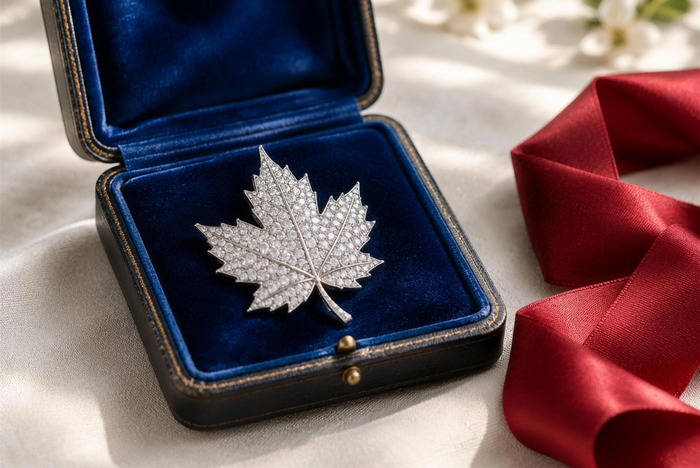
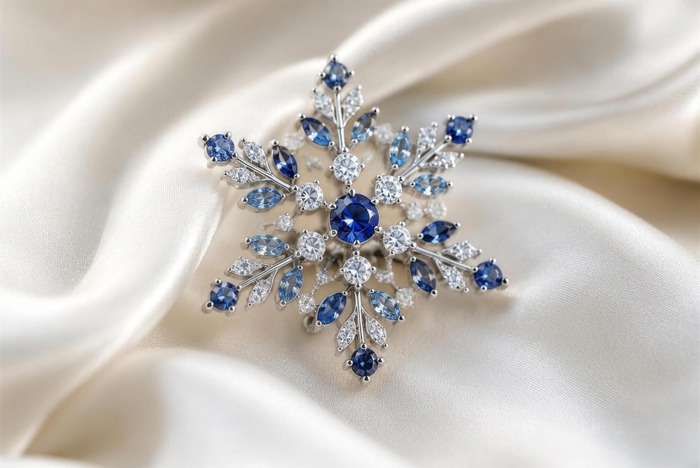
The famous diamond maple leaf brooch was bought from Asprey in London by King George VI in 1939. However, it was not made in Canada. The country’s own answer came in 2017, when Hillberg & Berk of Regina made the Sapphire Jubilee Snowflake Brooch with 48 Baffin Island sapphires and more than 400 northern diamonds.
- Part 1: The Engraved Cuff
- Part 2: Metal With a Past
- Part 3: The One Person Studio
- Part 4: Stones With a Canadian Address
- Part 5: The Nation’s Jewel, from the maple leaf brooch to the Snowflake (you are here)
On 26 May 2025, Queen Camilla stepped off the plane in Ottawa wearing a diamond maple leaf on her left shoulder. The brooch was 86 years old. It had crossed Canada on a Queen’s lapel in 1939, turned into a wartime symbol that autumn, and been lent to royal women visiting the country for more than half a century. That day, according to royal jewellery historians, it was worn on Canadian soil by a Queen of Canada for the first time.
Across four parts, this series has followed the cuff, the metal, the maker and the stone. This final part, then, follows what happens when they come together, in the jewels Canada gives, receives and awards when it needs to speak formally.
Who made the maple leaf brooch?
King George VI bought it from Asprey in London for Queen Elizabeth to wear on the 1939 royal tour. Princess Elizabeth borrowed it for her first visit to Canada in 1951 and inherited it in 2002. Since then it has been lent to Camilla in 2009 and to Catherine in 2011 and 2016.
However, the record holds one open question. Birks’ own heritage page says the Queen received a diamond maple leaf brooch of its making during the 1939 tour. Royal jewellery historians identify the famous brooch as Asprey’s. Still, the surviving record does not settle whether these are the same jewel or two different ones.
How has Canada spoken in metal since the maple leaf brooch?
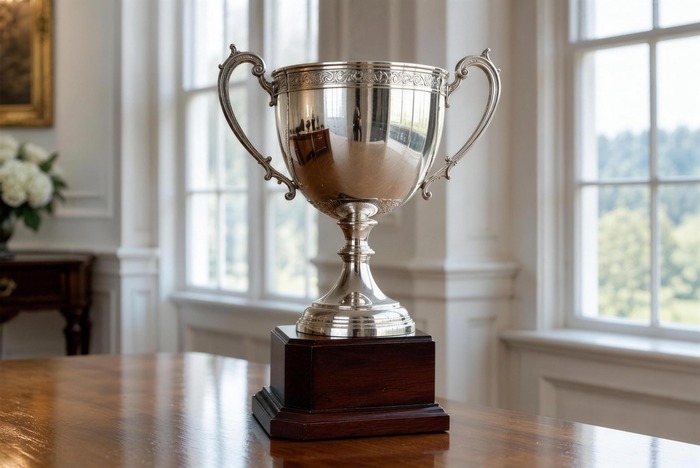
- 1892. Lord Stanley buys a silver bowl from G.R. Collis on Regent Street in London for 10 guineas. Soon, it becomes the Stanley Cup.
- 1909. Earl Grey orders a sterling cup on a wooden base for $48. He forgets about it, so the Grey Cup is not ready until March 1910.
- 1934. Birks, founded in Montreal in 1879, also receives a Royal Warrant.
- 1951. British Columbia gives Princess Elizabeth a diamond, emerald and platinum necklace through Birks. She later calls it the most beautiful gift she has ever received.
- 1962 to 1963. Montreal silversmith Carl Poul Petersen, who trained under Georg Jensen and worked for Birks, makes the Stanley Cup bowl still used today.
From the Order of Canada to the Olympic podium
- 24 November 1967. The first Order of Canada insignia are presented. Bruce Beatty designed them from a snowflake. However, Garrard, the Crown Jewellers in London, made them.
- 1967. At Expo 67, Walter Schluep makes a silver box as Canada’s gift to Madame de Gaulle.
- 1971. British Columbia commissions Toni Cavelti’s necklace for Queen Elizabeth II in BC gold and jade. He proposes adding 100 diamonds, but the province declines on cost, and he is paid $2,800.
- 2013. Saskatchewan presents the Queen with a tourmaline and diamond brooch designed by Rachel Mielke of Hillberg & Berk.
- 2015. Métis artist Christi Belcourt designs the Toronto Pan Am medals, struck by the Royal Canadian Mint with Ontario gold. In fact, they are the first Pan Am medals with Braille.
- 19 July 2017. The Governor General presents the Sapphire Jubilee Snowflake Brooch at Canada House in London, a gift from the people of Canada.
- 26 June 2025. Hillberg & Berk becomes official jewellery partner of the Canadian Olympic Committee through 2028, including a ring for every Team Canada Olympian.
Today, the Order of Canada insignia are made by hand at the Royal Canadian Mint in Ottawa. After more than half a century, Canada’s highest civilian honour is made at home.
Why does the Snowflake Brooch matter to the trade?
In short, it answers the 1939 brooch almost point for point. It was made in Canada, from Canadian stones, with every source named. For example, the 48 sapphires came from the Beluga occurrence near Kimmirut on Baffin Island, found by Seemeega and Nowdluk Aqpik and made public in 2002. The diamonds were also mined in the North. Furthermore, the brooch was designed as a companion to the maple leaf, and the Queen wore it from 2017 to 2022. In 2024, the Royal Canadian Mint put it on a $20 silver coin with a mintage of 6,500.
That is the lesson for any jeweller selling a significant piece. The value rests as much on the traceable story as on the stones themselves.
What is the commission and gift market worth for jewellers?
Canada publishes no figure for corporate jewellery gifting or private commissions. The tax rules, however, are clear. The Canada Revenue Agency lets an employer give non cash gifts and awards worth up to $500 a year, including tax, without creating a taxable benefit. A separate $500 limit applies to a long service award, which requires at least five years of service.
Meanwhile, the heritage houses are growing. Birks reported fiscal 2026 net sales of $205.4 million, up 15.5 per cent, with gross margin rising to 38.5 per cent.
| Gift | Year | Maker | Made in |
|---|---|---|---|
| Diamond maple leaf brooch | 1939 | Asprey | London |
| BC diamond and emerald necklace | 1951 | Birks | Canada |
| Order of Canada insignia | 1967 | Garrard | London |
| BC gold and jade necklace | 1971 | Toni Cavelti | Vancouver |
| Sapphire Jubilee Snowflake Brooch | 2017 | Hillberg & Berk | Regina |
| Order of Canada insignia today | Current | Royal Canadian Mint | Ottawa |
What should the trade take from the maple leaf brooch story?
First, build a gift program under $500. Offer local employers service pins and long service pieces priced within the CRA limits, including tax. After all, jewellery carries a meaning that a plaque cannot.
Next, give every commission an origin card. Name the metal, the stones, their source and the maker, then sign it. The Snowflake Brooch shows how much that paper is worth.
Pursue civic work. Provinces, municipalities and sports bodies have commissioned jewellery for more than a century. Then register with protocol offices and procurement portals, and keep a portfolio of one off pieces ready.
In the end, five threads run through this series: a crest cuff, reused metal, a maker working alone, a stone with an address and a gift that speaks for the country. Each fades and returns, yet each returns with its origin attached. The trade meets to put that into practice at the Time & Shine Jewellery Trade Show in Toronto on 1 and 2 November, Canada’s jewellery business marketplace, open to every jeweller with no membership or affiliation required. New Canadian work can also compete in the Canadian Jeweller Awards of Excellence, the country’s oldest jewellery design competition.
Frequently asked questions
Where is the Queen’s maple leaf brooch from?
King George VI bought it from Asprey in London in 1939 for Queen Elizabeth’s Canadian tour. Later, it passed to Elizabeth II in 2002 and remains with the Royal Family.
What is the Sapphire Jubilee Snowflake Brooch?
A white gold brooch set with 48 Baffin Island sapphires and more than 400 Canadian diamonds, made by Hillberg & Berk and presented to Queen Elizabeth II on 19 July 2017.
Who makes the Order of Canada insignia?
The insignia are made by hand at the Royal Canadian Mint in Ottawa. However, the first ones, in 1967, were made by Garrard in London.
Who made the Stanley Cup bowl?
The original was bought in London in 1892. Montreal silversmith Carl Poul Petersen made the replica bowl in use today in 1962 and 1963.
How much can an employer give an employee as a gift tax free in Canada?
Up to $500 a year in non cash gifts and awards, including tax, plus a separate $500 long service award after at least five years of service.
Sources: The Court Jeweller, May 2025 Ottawa arrival · Write Royalty, maple leaf brooch · Maison Birks, heritage · Historical Society of Ottawa, Lord Stanley’s Cup · Canadian Football Hall of Fame, Grey Cup · Maclean’s, 1954 · Carl Poul Petersen · Governor General, Order of Canada insignia · Order of Canada 50, 1967 · The Globe and Mail, Walter Schluep · City of Vancouver Archives, Toni Cavelti · ABC BookWorld, Toni Cavelti · The Court Jeweller, the Queen’s Canadian brooches · CBC, Pan Am medals · The Court Jeweller, Snowflake Brooch coin · Canadian Heritage, jubilees · Canadian Olympic Committee, Hillberg & Berk · Canada Revenue Agency, gifts and awards · Birks Group fiscal 2026 results

Author: Canadian Jeweller Editorial Team
The editorial team of Canadian Jeweller Magazine, Canada’s jewellery industry publication since 1879. We report on retail strategy, diamonds and gemstones, watches, precious metals, technology, and the business of jewellery across Canada. Editorial inquiries: editor@canadianjeweller.com.


