







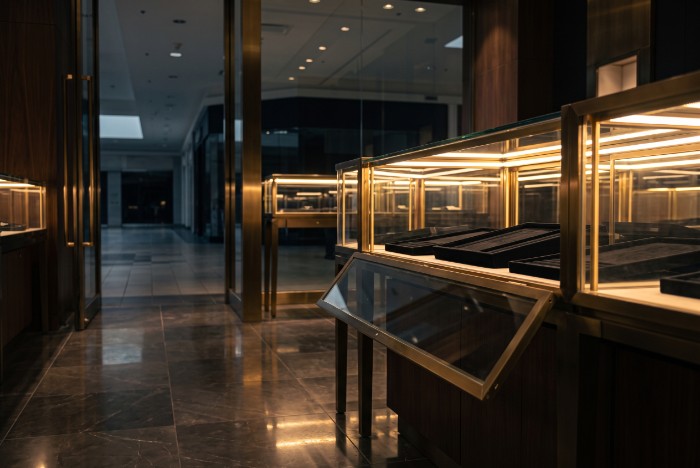
A Hamilton jewellery store robbery at CF Lime Ridge on the evening of August 18 lasted about as long as it takes to ring through one sale. Two masked males with hammers, a third watching the corridor, a car idling outside. Ontario police have been charting that exact shape since 2020.
Eight o’clock on a Tuesday. Doors open. The mall was still trading, the food court was still serving, and the upper level still had shoppers walking it. Hamilton Police say two suspects walked into Howard Jewellers carrying hammers, one silver and one yellow, and went straight at the display cases. A third male stayed outside in an all black tracksuit and watched. Investigators believe the group left in a newer model white Acura.
Nobody was hurt. Hold onto that. It is the only genuinely good line in the report, and on the evidence so far it was luck as much as anything the industry has built.
How the Howard Jewellers jewellery store robbery unfolded
This jewellery store robbery ran on a script Ontario investigators can now recite. Police describe two of the three suspects as males roughly 14 to 17 years old. One wore a white sweater, blue Nike shorts and a grey and black balaclava. The second wore a black hoodie, grey sweatpants and blue gloves. Both were masked, both gloved. That crew had thought about the identification problem before it walked in.
Hamilton Police have also made an unusual public request. Three witnesses appear to have recorded the robbery on their phones, and investigators want that footage. Anyone with information can reach Detective Constable Matt Raponi at 365 833 1701. The second contact is Staff Sergeant Dave Brewster, at 905 546 2991. Crime Stoppers takes anonymous tips at 1 800 222 8477.
Why this Hamilton jewellery store robbery fits a wider Ontario pattern
Two weeks earlier, at roughly three in the morning on August 5, about six masked people attacked Gold Forever Jewellery on Mohawk Road East. First, hammers came out. When the glass held, the crew drove a vehicle through the front of the building. Roughly $20,000 in stock went out the hole.
CF Lime Ridge has been here before as well. In January 2025, four suspects with hammers hit Peoples Jewellers on the same property at three in the afternoon. Police arrested one Toronto teenager. Meanwhile, three others got away.
Three stores. Nineteen months. These are separate investigations and police have not linked them, yet the method has clearly standardised across the province through nothing more complicated than repetition and imitation.
| Date | Target | Method | Status |
|---|---|---|---|
| August 18, 2026 | Howard Jewellers, CF Lime Ridge, Hamilton | Two suspects with hammers, third as lookout, white Acura | Under investigation |
| August 5, 2026 | Gold Forever Jewellery, Hamilton Mountain | Hammers, then a vehicle through the storefront, about six suspects | About $20,000 taken, no arrests reported |
| January 25 to March 17, 2026 | Ten stores in Burlington, Guelph, Brantford, Waterloo, St. Catharines, Hamilton and Barrie | Stolen vehicles on cloned plates, masks, hammers | Project Pinnacle: eight arrested, more than 50 charges |
| January 28, 2025 | Peoples Jewellers, CF Lime Ridge, Hamilton | Four suspects with hammers, mid afternoon | One Toronto teenager arrested |
Halton Regional Police laid out the commercial logic of it when they closed Project Pinnacle in the spring. Eight people arrested. More than 50 charges, ten robberies inside eight weeks and across seven cities, with four of the accused already on some form of release when officers came for them.
Who is actually carrying out these jewellery store robberies
Mostly, teenagers. Ontario jewellery store robbery files keep returning the same age range. Peel Regional Police have reported that minors were involved in roughly 40 per cent of their robbery cases over a three year span. In one Ontario file a 16 year old was offered $2,000 to do the job. Investigators in York Region watched jewellery store robberies double in a single year. Toronto Police counts climbed from 10 incidents in 2020 to 48 in 2024.
How the recruitment chain works
The recruitment works because the recruiters are not the ones going through the door. Older organisers assemble a crew over group chats, supply the car and the hammers, and keep the goods. Meanwhile, the young people take the charge. Recruiters tell them a jewellery store robbery is victimless because the store carries insurance. Nobody in that chain has ever met a store owner.
How gold prices raise the stakes
Gold sets the incentive. It also makes the arithmetic worse. Bullion traded near US$4,490 an ounce on August 20, up more than 34 per cent in twelve months. At that level even mid range inventory is worth breaking a case for. The melt floor under every gold item has climbed faster than the retail price tag on it. Afterwards, stolen pieces rarely stay recognisable for long. Much of it gets reworked and returns to the legitimate market.
What changed in Canadian law on July 15
Bill C-14, the Bail and Sentencing Reform Act, received royal assent on June 15, 2026 and came into force on July 15. It carries more than 80 Criminal Code amendments, and two of them matter directly to jewellers. We covered the retail theft provisions in detail when the bill passed, in our breakdown of Bill C-14 for Canadian jewellers.
First, sentencing courts now treat organised retail theft as an aggravating factor. Where an offender commits robbery, break and enter, theft or possession of property obtained by crime with the intention of selling, bartering or fraudulently returning the goods, that commercial motive counts against them at sentencing. Moreover, prosecutors do not have to prove membership in a criminal organisation.
Second, the reverse onus at bail has widened. Anyone charged with an offence involving violence, threatened violence or a weapon now faces that onus if they have a similar conviction within ten years rather than five. The Act also amends the Youth Criminal Justice Act. Police gain a narrow power to publish identifying information about a youth without a court order in urgent situations.
None of this creates a minimum sentence and none of it stops a hammer. What it does is give a Crown something concrete to argue with when the same names keep coming back. For retailers the takeaway is smaller and more useful. Detailed loss documentation and clean evidence carry more weight now than they did in June.
Where cameras stop preventing a jewellery store robbery
Recording a robbery is not preventing one. Every store in the Ontario incidents above had cameras running, and every crew wore a balaclava and gloves, which is why the footage keeps producing tips rather than identifications. So the cameras did their job. That job, however, is not prevention. Not one jewellery store robbery in the table above failed for want of footage.
Prevention lives in the seconds before and during. Not afterwards. Store layout does a surprising amount of that work, as we set out in this guide to theft prevention through showroom design. Stores that come through these attacks with the least damage tend to stack several small delays on top of each other, until a crew built for speed runs out of the one thing it planned around.
| Layer | What it buys | Where it commonly fails |
|---|---|---|
| Recorded video | Evidence and prosecution support | Masks and gloves defeat identification |
| Laminated or security rated showcase glass | Strike time, often the difference between one case and four | Older cases rated for a single blow |
| Case locks and tray tethering | Forces a second problem after the glass | Cases left unlocked during trading hours |
| Security fog systems | Removes the visibility a fast crew depends on | Mall installs need landlord and fire approvals, so open that conversation with the supplier early |
| Duress alarm and mall radio link | Cuts response time | Rarely tested on evening and weekend shifts |
| Closing and high risk hour merchandising | Reduces what is reachable at the worst moment | Highest value pieces left out through the final hour |
One rule sits above all of it. Staff should never be asked, encouraged or trained to physically defend merchandise. The insurance covers the stock. Still, it does not replace an employee.
How the Canadian and American numbers compare
South of the border, where the Jewelers’ Security Alliance tracks industry crime year over year, total dollar losses reached US$144.7 million in 2025 while the number of crimes fell 13.2 per cent. Fewer incidents, more money per incident, and a sharp rise in violence: robberies involving violence went from 16.9 per cent to 27.1 per cent. Canada has no equivalent national dataset. Statistics Canada folds robbery into broader violent crime reporting. It publishes no jewellery specific count. So the Canadian picture gets built store by store, police release by police release.
What a jeweller can change this week
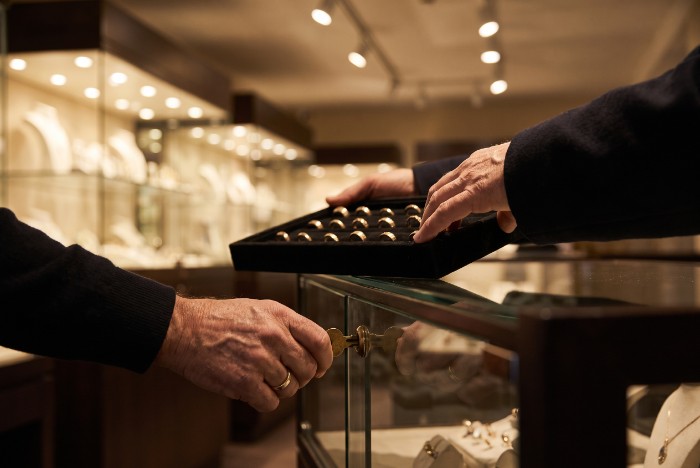
Start with the last hour of trading, because that is when Howard Jewellers was hit and when staffing is thinnest. So pull the highest value trays before the mall corridor empties out rather than after.
Then audit the glass. All of it. Ask the case supplier what rating the units carry and how many blows they are built for. Many Canadian showrooms still trade on cases specified before 2020. Back then the threat model was one opportunist, not a rehearsed crew.
After that, test the radio. For example, call mall security from the sales floor at eight on a Tuesday and time the answer. A protocol that works at eleven on a Wednesday morning is not the one running at closing.
Finally, cost out a jewellery store robbery beyond the stock. Closed days, replacement cases, and the staff who do not come back. Insurance settles inventory. Everything else, though, lands on the owner. Our running coverage of Canadian jewellery store robberies tracks how these incidents accumulate across the country.
The crews are getting faster. They are also getting younger, and the people directing them have worked out that a 15 year old carries a lighter consequence than a 25 year old. The industry response has to get slower, denser and better documented. That part of the equation is the one Canadian retailers control.
Frequently asked questions
What happened in the Hamilton jewellery store robbery at CF Lime Ridge
Hamilton Police say three suspects targeted Howard Jewellers at CF Lime Ridge at approximately 8:05 p.m. on August 18, 2026. Two entered with hammers and smashed display cases while a third acted as a lookout outside. Investigators believe the group fled in a newer model white Acura.
Have there been other jewellery robberies in Hamilton recently
Yes. Twice this month, in fact. About six masked suspects hit Gold Forever Jewellery on Mohawk Road East on August 5, 2026. A vehicle went through the storefront and roughly $20,000 in stock disappeared. Peoples Jewellers at CF Lime Ridge was targeted by four suspects with hammers in January 2025. Police have not indicated the incidents are connected.
Why are so many suspects in Canadian jewellery robberies teenagers
Older organisers recruit minors through social media and group chats. They supply the vehicle and the tools, and they keep the goods. Peel Regional Police have reported minors involved in roughly 40 per cent of robbery cases over three years. Recruits are frequently paid a flat fee and told the crime is victimless because the store is insured.
Does Bill C-14 change anything for jewellery retailers
It does. Since July 15, 2026, courts treat theft, robbery, break and enter and possession of stolen property committed with the intention of reselling the goods as an aggravating factor at sentencing. The reverse onus at bail also now captures prior violent or weapons convictions within ten years instead of five. This is general information and not legal advice.
What security measures reduce jewellery store robbery losses
Layers rather than any single product: security rated showcase glass, locked and tethered trays, security fog, tested duress alarms linked to mall security, controlled merchandising during high risk hours, and clear staff protocols. Cameras remain essential for evidence but do not prevent an attack. Employees should never be asked to physically defend merchandise.
Sources
CHCH News · Hamilton Police Service · Urbanicity Hamilton · CP24 · Halton Regional Police Service · CBC News · Department of Justice Canada · Statistics Canada · Jewelers’ Security Alliance

Author: Olivier Fel.
Olivier Felicio is the founder and publisher of Canadian Jeweller Magazine, Canada's jewellery business publication since 1879. He writes on retail strategy, market data, trade policy and the commercial side of the Canadian jewellery and watch trade, and hosts Time and Shine, Canada's jewellery buying event. Contact: olivier@canadianjeweller.com.


