







The oldest jewellery magazines still publishing are JCK, founded in New York in 1869, and Canadian Jeweller, founded in Toronto in 1879. Germany’s GZ Goldschmiede Zeitung (1898) and National Jeweler (1906) follow. Six gem, trade and craft journals born between 1934 and 1974 complete the list of ten.
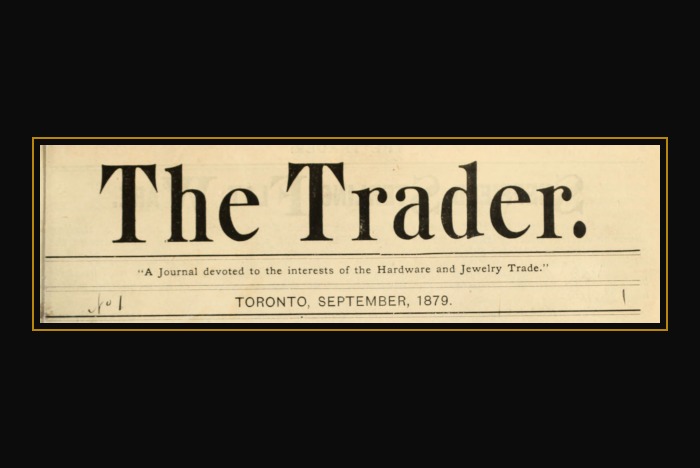
In September 1879, a new monthly went out from Box 635 in Toronto with a promise and a business model. It promised to discuss the trade from “a purely independent standpoint.” It also vowed to “use no uncertain trumpet sound in declaring the right.” The business model fit in one line: “our revenue is derived entirely from our advertisements.” A full page cost $15. The paper was called The Trader, and today it publishes as Canadian Jeweller.
Only nine other jewellery titles in the world have lasted anything like that distance. Between them they have survived an air raid, a staff walkout, a pearl panic and the Great Depression. One was even founded by a fish scientist. Each of them, it turns out, stayed alive by taking on a second job the trade could not do without.
What are the oldest jewellery magazines still publishing?
| # | Title | Year | Country | The second job that keeps it alive |
|---|---|---|---|---|
| 1 | JCK | 1869 | United States | A Las Vegas trade show, launched in 1992 |
| 2 | Canadian Jeweller | 1879 | Canada | Canada’s oldest jewellery competition, Time & Shine Jewellery Trade Show, marketing and AI services |
| 3 | GZ Goldschmiede Zeitung | 1898 | Germany | Judging the goldsmith and jeweller awards at Inhorgenta |
| 4 | National Jeweler | 1906 | United States | Ownership by Jewelers of America since 2015 |
| 5 | Gems & Gemology | 1934 | United States | The Gemological Institute of America and its laboratory |
| 6 | L’Orafo Italiano | 1946 | Italy | Italy’s goldsmith districts, from Arezzo to Vicenza |
| 7 | The Journal of Gemmology | 1947 | United Kingdom | Gem A and the diploma that trains gemmologists worldwide |
| 8 | The Australian Gemmologist | 1958 | Australia | The Gemmological Association of Australia |
| 9 | Revue de Gemmologie AFG | 1961 | France | The Association Française de Gemmologie |
| 10 | Ornament | 1974 | United States | Its founding family, now in the second generation |
Founding years are the first issue of the title or its direct predecessor. Only titles publishing in September 2026 are ranked.
One name on that list also owns a record of its own. Canadian Jeweller runs the oldest jewellery competition in Canada, the Awards of Excellence. In recent years it has aimed that competition squarely at young jewellers. The designer prize once carried a $2,000 cash award and a year of mentorship with an established designer. Winners also received a marketing package with professional photography and press support. The magazine then gave its whole December 2025 edition, the Generation Next issue, to the jewellers coming up behind today’s trade.

The watch paper that bet on Las Vegas
The oldest jewellery magazine on earth began as a watch paper. G.B. Miller launched The American Horological Journal in July 1869 at 229 Broadway in New York, the lot where the Woolworth Building later rose. In February 1870, Daniel H. Hopkinson started The Jewelers’ Circular. By his own paper’s account, he “vigorously denounced all frauds.” He died in 1884 at 44, which is roughly what that job description will do to a man.
The two papers merged in 1873, swallowed two more rivals around 1900, and joined Philadelphia’s The Keystone in 1935. By 1980, it was the most profitable magazine its publisher owned. It even out earned a steel industry journal called Iron Age. The three letters JCK only arrived in January 1990.
Its biggest bet came next. In 1991, Jewelers of America sold its own trade show to a British events company for $36 million. Many exhibitors disliked the result. So the magazine launched a rival in Las Vegas. Veterans warned that retailers “will spend all their money gambling.” Instead, Jewelry ’92 opened with 1,270 exhibitors and more than 6,000 buyers. Staff handed out lunch tickets to a queue two blocks long. The show has been the magazine’s second engine ever since. It even survived September 1997, when all but two salespeople and three editors quit together to start a competing magazine.
An ice cube in the desert
National Jeweler dates itself to 1906. Decades later, the publisher Milton Gralla bought it from a late owner’s estate. He called the purchase “like an ice cube in the desert.” He took it from last place to first in its field. By 1977 it came out twice a month with close to 200 advertising pages an issue. That kind of thickness now belongs only to wedding catalogues.
It went digital only in 2010. In January 2015, Jewelers of America bought it. The deal reunited two organisations born in 1906 that had spent 109 years apart. Print has since come back, at more than 10,000 copies.
The Leipzig paper that restarted on cheap paper
In 1898, the Leipzig bookseller Wilhelm Diebener founded a paper with a name built for patience: Handels Zeitung für die Gold und Silberwarenindustrie. It became Deutsche Goldschmiede Zeitung in 1925. Wartime bombing then destroyed its building. From 1947, the title limped back as duplicated newsletters on cheap paper. Watchmakers and goldsmiths received them by mail until the paper rebuilt itself in Stuttgart.
Its 320 page anniversary issue recalled a 1906 swindle that promised the trade quick money from abroad. It was the advance fee scam, a century before it found email. GZ now prints about 5,500 subscribed copies a month. It also helps judge the goldsmith and jeweller of the year awards at Inhorgenta in Munich. Proudly, it calls itself the oldest jewellery and watch trade magazine in the world. That claim is best not repeated in New York or Toronto.
The failed jeweller who gave the trade the 4Cs
Robert M. Shipley ran a jewellery store in Wichita, Kansas, and his customers kept asking questions he could not answer. The store failed. So he moved to Paris and enrolled in a British gem correspondence course. By any standard, that is a bold response to bankruptcy.
Back in Los Angeles, he founded the Gemological Institute of America. In January 1934, deep in the Great Depression, he launched Gems & Gemology. Its first cover promised a periodical “without paid advertising.” The subscription cost $3.50 a year and stayed there for more than four decades. In the early 1940s, Shipley coined the 4Cs as a memory aid for his students. In 1953, the institute started its colour scale at D. The point was to escape the inflated “AAA” grades already abused on counters.
Richard T. Liddicoat then edited the journal for half a century, from 1952 until his death in 2002. Under him and his successors, it published the papers the trade still quotes. In 1971 it reported on General Electric’s cuttable synthetic diamonds. In 1999 it studied 960 diamonds improved under high pressure and heat. In 2003 it exposed beryllium diffused rubies and sapphires. In 2006, the institute put all 192 issues from 1934 to 1980 online for free.
The London lab born of a pearl panic
The course Shipley took came from London, and it had a curious birth. In 1908, a jeweller named Samuel Barnett pushed his goldsmiths’ association to create an education committee. The first examinations followed in 1913. Barnett himself received the first Diploma in Gemmology, which is one way to make sure a new standard gets met.
When Mikimoto’s cultured pearls reached the market in the early 1920s, London jewellers panicked. Their answer, in 1925, was the world’s first gem testing laboratory. Basil Anderson ran it until 1979 and, with C.J. Payne, invented the Chelsea Colour Filter in 1934, a tool still sold today. In 1945, a Dublin collector sent Anderson an odd pale stone. It became taaffeite, the only gem species ever identified from a stone that had already been cut. The discovery appeared in a mineralogy journal, so the house paper missed its own scoop.
That house paper arrived in 1947 as The Journal of Gemmology and Proceedings of the Gemmological Association of Great Britain. No business card could hold it. Today Brendan Laurs edits the journal, published with the Swiss Gemmological Institute SSEF. Its impact factor of 1.1 is respectable for a science most people meet only at the engagement counter.
Opals, Athens and a $12 subscription
On 29 October 1945, twenty one men met on Pitt Street in Sydney. They founded the Gemmological Association of Australia. For its first years, their papers appeared as a “Gemmology Review” tucked inside a jewellers’ trade paper. The association’s own journal, The Australian Gemmologist, launched in July 1958 with 36 pages. Around 1982, editors Bill and Rose Hicks assembled issues while travelling through Florence and Athens. That is one way to handle a deadline. By 1983, readers in 30 countries paid $12 a year. Later issues covered Argyle’s pink diamonds and the vocabulary of opal.
In Paris, a customs official founded the Chamber of Commerce gem laboratory in 1929. Its former students later formed the Association Française de Gemmologie at Daniel Piat’s initiative. The Revue de Gemmologie prints about 750 copies a quarter and costs €68 a year in France. Auctioneers are among its most loyal readers. Issue 230 appeared in June 2026.
Italy’s entry, L’Orafo Italiano, was born in 1946, the year the country voted to become a republic. Published from Milan, it follows the goldsmith districts of Arezzo and Vicenza and celebrated its 80th anniversary in May 2026.
The fish scientist who founded a jewellery magazine
Robert K. Liu earned his UCLA doctorate in 1969 studying the mating behaviour of pupfish. Then he moved into ageing research. Beads were the hobby. In 1974, with Carolyn L. E. Benesh, he started The Bead Journal, funded by $1,500 from the family of his late professor, Boyd Walker. It had fewer than 300 subscribers. Pages were typed, with photographs pasted in by hand, cut and paste in the original sense.
Renamed Ornament by the end of the decade, it became a record of American studio jewellery. It also sponsors an award at the Philadelphia Museum of Art Craft Show. Benesh died in 2020. Their son Patrick joined while still in high school and now co edits it. Volume 47 arrived in August 2026.
Free to every jeweller and hardware dealer in Canada
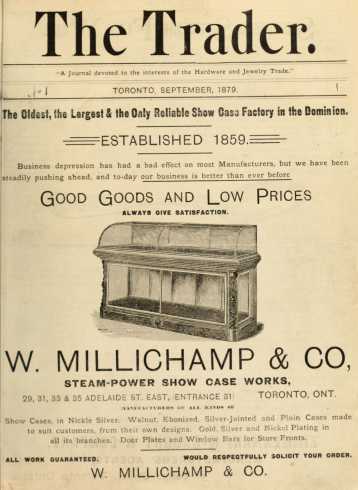
The Trader’s jewellery readers had to share. Its subtitle read “A Journal devoted to the interests of the Hardware and Jewelry Trade,” American spelling included. It went “free of expense to every Jeweller and Hardware Dealer in Canada.” A free publication paid for by advertisers is, of course, the model every newsletter launched in 2026 believes it invented.
The paper earned its keep quickly. A chain maker announced that swivels stamped R.W. & Co. would assay to half the value of pure gold. That is a 12 karat promise, and precisely the kind of stamp the magazine’s guide to precious metal testing still tells jewellers to verify. In 1882, a jeweller named W.C. Fox lost $3,000 in goods. The paper then told readers to trust their old key lock safes no “longer than it will take you to get a new and modern safe.” The same year, it compared American export figures with Canadian imports and found a smuggling gap of $2,808,764. Toronto’s wholesale jewellery trade, it reported, ran to $750,000 a year, three quarters of it imported. That March, it described a live beetle sold as a shawl pin, on a gold chain with a tiny gold padlock. In fairness, it was the only piece in the showcase that could walk out on its own.
By January 1900, it claimed “a circulation embracing every solvent Jeweler in the Dominion.” That is a refreshingly honest way to define an audience. That issue also sent a sombre editorial after the thousand Canadians fighting in South Africa. In 1920, Ottawa jewellers grumbled that business “has not been any too brisk since the luxury tax has hit them.” In the same volume, a jeweller named Nathan Jacobs was forced at revolver point to open his safe and lost $2,075 in cash and stock. Security, taxes and smuggling were already the trade’s permanent agenda.
The year the volume numbers jumped
From July 1953, every July issue carried an Annual Directory and Buyers’ Guide for the Canadian trade. In June 1958, the word Trader finally dropped off the masthead. Somewhere in that era the volume numbers also slipped, and volumes 77 and 78 went to press labelled 80 and 81. The magazine had grown old enough to lose count of its own age.
The Toronto publisher Maclean Hunter held the title for part of the twentieth century. One of its editorial assistants on Canadian Jeweller, John Milne, later became a senior vice president at Rogers Publishing. Later still, Style Communications published it alongside the fashion trade title Style. In July 2001, Rod Morris bought his partner Pat MacLean’s half of the company. In April 2008, Morris paused both titles. A month later, Rive Gauche Media took over with Olivier Felicio as owner and publisher. The country’s oldest jewellery title was back on press. Those initials are still on the door: RGM stands for Rive Gauche Media.
Half a century of handing out trophies
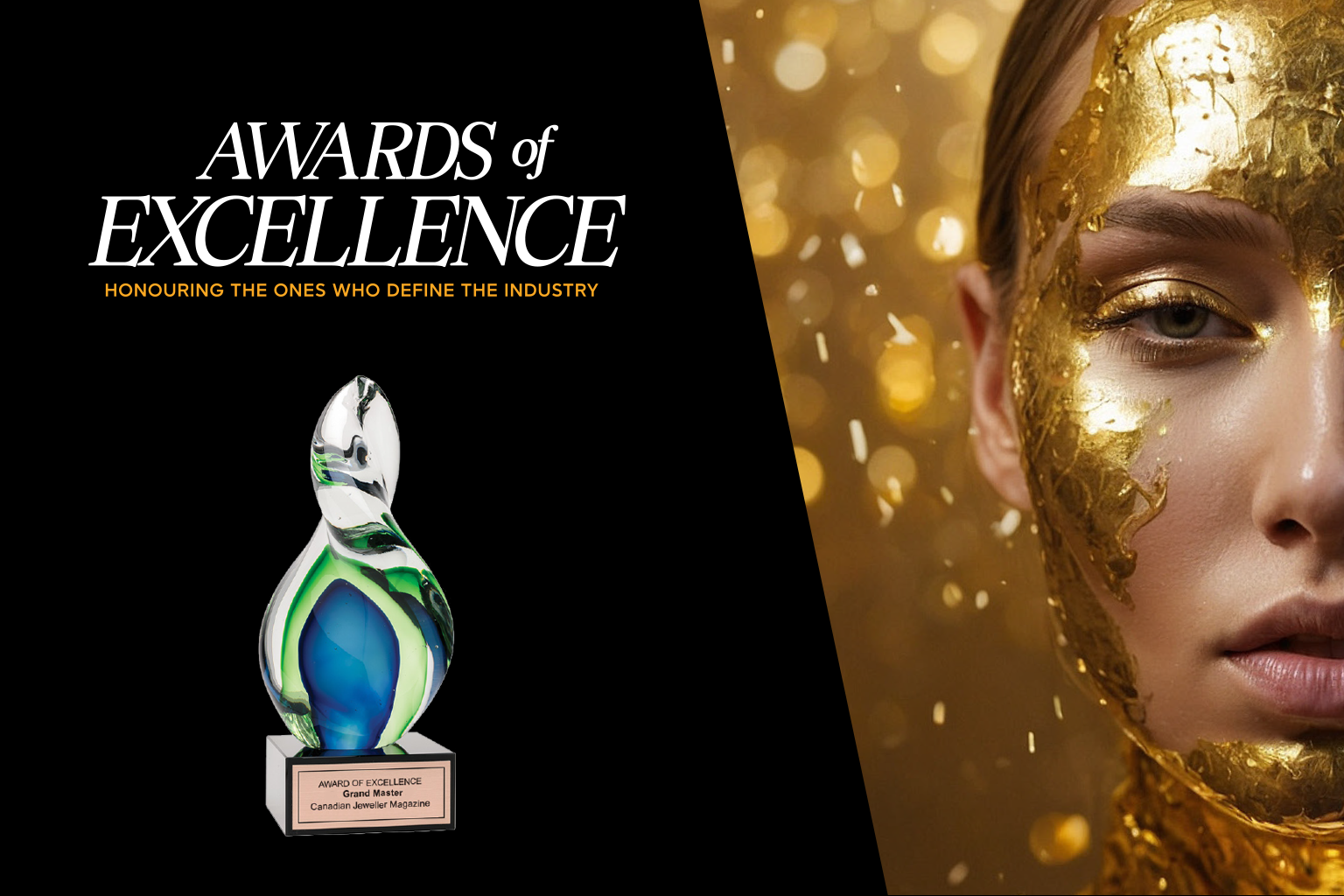
Long before newsletters and trade shows, the magazine found another way to keep jewellers reading: it gave them something to win. That competition began in the late 1960s as a jewellery design contest and has now run for more than 50 years.
Its winners’ lists read like a map of the Canadian trade. In 2013, the honours went to Diamond Gallery in Winnipeg and Bogart’s in Newfoundland. Designers Jeff Nechka, Donald Stuart, Karin Bunzeit and David Abugov won for platinum, pearl, Canadian diamond and coloured gems. In 2015, Peter Jiliaev won the Canadian Diamond category with a 2.29 carat CanadaMark stone. The Jiliaev name appeared on that list more than once. The 2026 edition, sponsored by EDOX, judged 12 categories and closed with a gala in Toronto in April.
What kept Canadian Jeweller alive for 147 years?
Every time the trade changed shape, the magazine changed with it. It narrowed from hardware and jewellery to jewellery alone. When buyers needed suppliers, the July issue turned into a directory. When the industry wanted a stage, the competition built one. Later, the printed magazine gained a website, a newsletter and finally a trade show floor, and it kept printing through all of it.
The 1879 formula also survived almost untouched. Advertisers still pay for the reach, and readers still get the paper because they work in the trade. Today the print edition goes to 3,200 individually addressed, verified industry subscribers, delivered to head offices where buying decisions are made. The 1882 safe warning, the 1953 buyers’ guide and this year’s gold testing guide share one reader. That reader is a jeweller deciding what to buy and whom to trust.
The famous names that did not make the cut
Lapidary Journal looked unstoppable. Lelande Quick founded it in April 1947 so readers could “create deathless things of beauty.” By 1951 it reached 25,000 readers an issue. Its 1976 volume ran to 2,864 pages, heavy enough to prop open a workshop door. Nevertheless, its publisher mailed the final issue in September 2021 and pointed readers to its digital platforms.
The Journal Suisse d’Horlogerie, founded in 1876, is older than any Canadian title. However, it went bankrupt in 2002 and now survives mainly as a brand and an archive. The United Kingdom’s Retail Jeweller is active and widely read, and its roots are often traced to a 1925 Birmingham bulletin. No primary record of that date has surfaced yet, so it waits outside the ranking.
What does Canadian Jeweller do in 2026?

The free hardware circular is still a printed magazine. Today it also publishes a digital issue every two weeks and a weekly newsletter. Around it sits a full service digital marketing practice for retailers and wholesalers, covering email, social media, sales automation and AI training. Gemify, its newest arm, builds AI agents that handle sales, service and marketing for jewellers.
The biggest addition is the Time & Shine Jewellery Trade Show. Canadian Jeweller hosts it three times a year, twice in Toronto and once in Edmonton, now the largest jewellery show in the country. More than 30 per cent of Canadian jewellery retail attends. No membership or affiliation is required, and orders are written on the floor.
The next edition opens in Toronto on 1 and 2 November 2026. It is the only delivery jewellery show in Canada. It is also the last chance to meet suppliers before the holiday season, while jewellers still have cash to place. Retailers, designers and buyers can register as trade attendees here. Suppliers who want a table in front of that room can reach the team through timeandshineexpo.com.
Frequently asked questions
Is Canadian Jeweller the oldest magazine in Canada?
No. Broadview, founded in 1829 as the Christian Guardian, is older. Canadian Jeweller is the oldest jewellery trade publication in Canada and the second oldest in North America, after JCK.
Can anyone read the first issues of The Trader?
Yes. Canadiana holds 81 issues from September 1879 to December 1886, digitised from the Thomas Fisher Rare Book Library at the University of Toronto. They are free to read under catalogue record oocihm.8_04471.
What is the oldest watch magazine still publishing?
The Horological Journal of the British Horological Institute, first published in September 1858. The institute says it has appeared monthly ever since without fail, which is why it calls itself the oldest continuously published technical journal in the world.
How many people read Canadian Jeweller?
The newsletter has more than 18,000 active subscribers with an open rate of about 40 per cent, and the website draws more than 50,000 unique visitors a month.
When are the Time & Shine Jewellery Trade Shows in 2027?
Toronto runs on 18 and 19 April 2027, and Edmonton on 12 and 13 September 2027. A November Toronto edition follows later in the year.
Sources: Canadiana, The Trader serial record · Internet Archive, The Trader 1879 to 1881 · Internet Archive, 1882 to 1886 · Internet Archive, 1900 · Internet Archive, 1920 · Masthead, May 2008 · Masthead, March 2002 · Presseportal, GZ at 125 · GIA, 80 years of Gems & Gemology · GIA, history of the 4Cs · GIA, GE processed diamonds 1999 · Gem A, history · Gem A, Basil Anderson · Gemmological Association of Australia · AFG, Revue de Gemmologie · L’Orafo Italiano at 80 · Ornament at 50 · Currently Rockhounding, Lapidary Journal · British Horological Institute · Canadian Jeweller, previous winners

Author: Canadian Jeweller Editorial Team
The editorial team of Canadian Jeweller Magazine, Canada’s jewellery industry publication since 1879. We report on retail strategy, diamonds and gemstones, watches, precious metals, technology, and the business of jewellery across Canada. Editorial inquiries: editor@canadianjeweller.com.


