







Quick answer: In precious metal testing, no single check sees a whole piece. Acid and XRF analysers read the outer metal, and a scale cannot separate gold from tungsten, so a bar needs an interior check or a refiner’s assay. In Canada, the testing tools also bring workplace safety and registration duties with them.
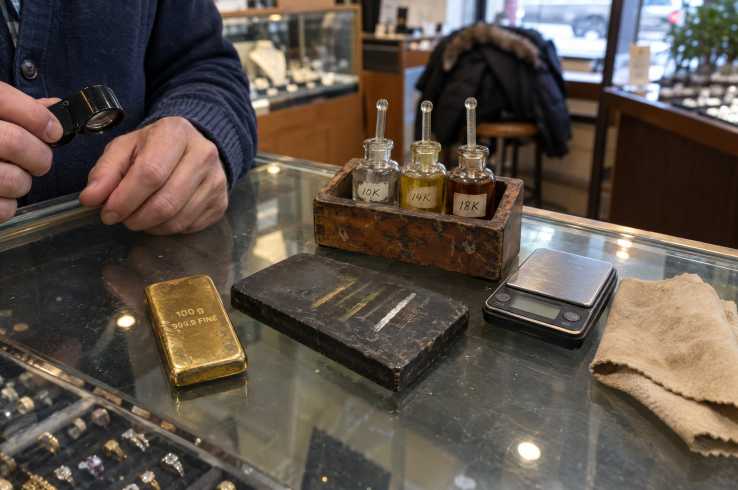
On a quiet Saturday, a customer lays a 100 gram bar on your glass. The stamp is sharp, the refiner’s name is familiar, and the acid leaves the streak untouched. When the scale confirms the weight printed on its face, every sign points to paying him.
Each of those checks, however, examined only the outside of the bar, and none of them could say what lies at its centre.
That gap is the real risk at a buying counter. Every method of precious metal testing sees only so far into a piece. A store that knows where each one stops can tell when a quick check is enough and when to look further. The same tools also bring obligations into the back room, and those are easy to overlook when the equipment first arrives.
What does an acid test prove?
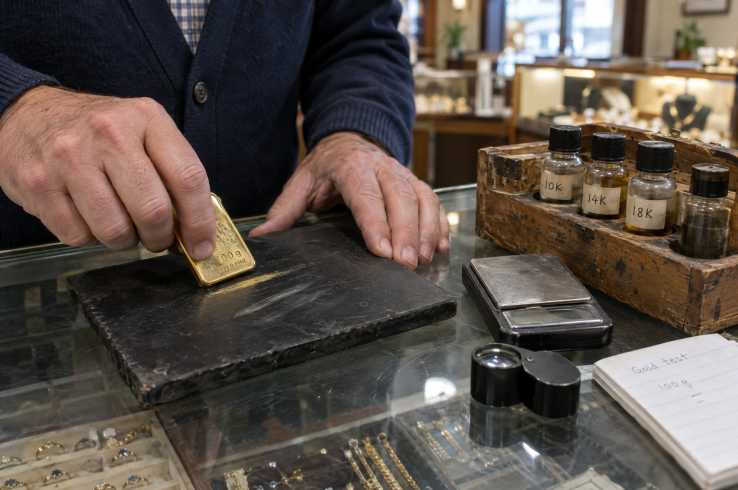
In precious metal testing at a busy counter, the touchstone remains the quickest verdict. A buyer rubs the piece on the stone, touches the streak with acid and watches whether the mark survives. GIA describes the method as fast and relatively nondestructive.
The streak, though, comes from the surface alone, so it says nothing about what lies underneath. A heavy layer of karat gold bonded over brass will streak exactly like solid gold, although the brass beneath it is worth a fraction as much.
The bottles deserve as much attention as the results. Testing acids are corrosive, which is why GIA recommends gloves, safety goggles and good ventilation. They also fall under WHMIS, the national system for hazardous products at work. An employer that keeps them must label the containers and keep a current safety data sheet on hand. Staff must be trained on the hazards and on what to do in an emergency.
How far does an XRF analyser see?
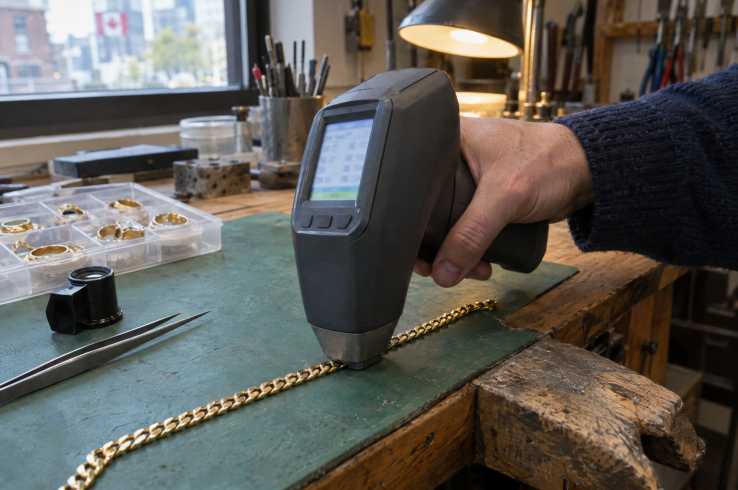
An XRF analyser goes further than acid. It identifies the elements in the alloy and returns a karat figure within seconds, without leaving a mark. For a store that buys gold every week, that speed lets staff check far more pieces properly before anyone is paid.
Its reading still comes from the outer layer of the metal. On most rings and chains that limit causes little trouble. A thick gold shell around a different core, however, can produce a result that looks perfectly clean.
The instrument also generates X rays, and provinces regulate it for that reason. Ontario handles this through Radiation Protection Services, part of the Ministry of Labour, Immigration, Training and Skills Development. There, an employer must register a new radiation source and receive approval before using it, and the guidance names handheld XRF units as an example. Alberta likewise requires employers to register analytical equipment of this kind through an authorized agency. Elsewhere, the rules vary by province.
Why can’t a scale catch a tungsten bar?
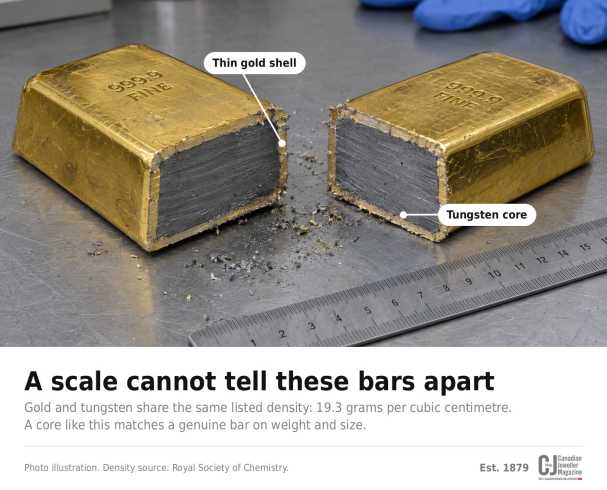
That leaves the scale, which often serves as the final word on bullion. Yet the Royal Society of Chemistry lists gold and tungsten at the same density, 19.3 grams per cubic centimetre. As a result, a bar with a tungsten core can match a genuine bar in both weight and size. Neither a precise scale nor a water displacement test will reveal the difference.
On karat jewellery the test still earns its place, because a 14 karat alloy has a known density that an imitation rarely matches. With a bar of fine gold, that safety margin disappears.
Seeing inside a bar therefore takes a different kind of instrument. Conductivity testers and ultrasonic gauges examine the metal beneath the surface, and a refiner’s fire assay settles the matter by melting a sample. When a bar arrives with no known history, those are the only methods that can answer the question that matters.
What must the stamp in your showcase prove?
Precious metal testing does not end with what a store buys, because the store also answers for the marks on what it sells. Under the Precious Metals Marking Act, which the Competition Bureau administers, a quality mark is voluntary. Once applied, however, it must be accurate within set tolerances and must appear alongside a trademark that is registered or applied for in Canada.
Those tolerances leave very little room.
| Metal and quality | Allowance without solder | Allowance with solder |
|---|---|---|
| Gold, 9 to 24 karat | 3 parts per 1,000 | 7 parts per 1,000 |
| White gold, 18 karat and above | 3 parts per 1,000 | 15 parts per 1,000 |
| Silver, .925 or better | 2 parts per 1,000 | 6 parts per 1,000 |
| Platinum and palladium | No allowance, at least 95 percent | No allowance, at least 95 percent |
Consider a soldered chain stamped 14K. Fourteen karat equals 583 parts gold per 1,000, so with the allowance of 7 parts the chain must test at 576 or higher. A reading of 570 would place it outside the permitted tolerance, no matter who made it. (Illustrative arithmetic based on the Competition Bureau’s published tolerances.) Our guide to precious metals markings and trademarks explains how the trademark requirement works in practice.
What health rules travel with the jewellery?
Some obligations follow a piece out the door. Health Canada’s Children’s Jewellery Regulations cover pieces made, packaged, advertised or sold to appeal mainly to children under 15. Those items may contain no more than 90 mg/kg of lead, and any item small enough to fit inside the regulation’s test cylinder for small parts also faces a cadmium limit of 130 mg/kg. Health Canada has recalled children’s necklaces and charm sets that exceeded those limits.
In a fine jewellery store, the rules usually touch the edges of the assortment, such as baby bracelets, charm lines and holiday novelties.
A broader duty covers everything the store sells. Section 14 of the Canada Consumer Product Safety Act applies to anyone who makes, imports or sells a consumer product commercially. When an incident occurs, that business must tell Health Canada and its supplier within two days of learning about it. An incident includes a serious adverse health effect that occurred or could reasonably have been expected. It also includes a recall of the same product in another jurisdiction for health or safety reasons.
What stands behind a recycled gold claim?
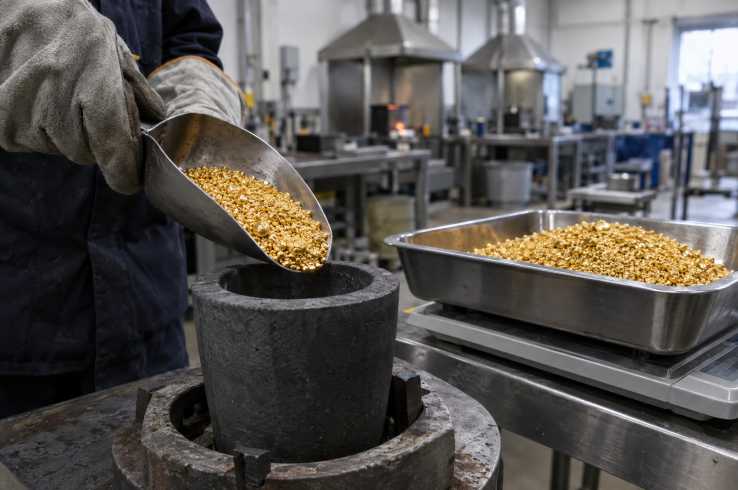
Gold also carries a history, and that history is where the environmental risk lies. According to the United Nations Environment Programme, artisanal mining supplies about 12 to 15 percent of the world’s gold. The same sector accounts for an estimated 37 percent of global mercury releases to air, water and land. Canadian data on how much of the gold in this country’s jewellery comes from such mines is unavailable, and we could not find a published estimate.
A store cannot audit a mine, although it does control what it tells customers. Under the Competition Act, a claim that a product benefits the environment must rest on adequate and proper testing. When the Budget Implementation Act, 2025, No. 1 received royal assent on March 26, 2026, Parliament narrowed the greenwashing provisions, yet that requirement for product claims remained in place.
Words such as “recycled” and “responsibly sourced” are therefore promises about origin. The evidence for them sits with the refiner that processed the gold. A refiner’s assay is the final stage of precious metal testing, so assay reports and records of recycled content now belong in the marketing file as well as in the accounts. Primary refiners that assay every lot, such as the one in our refining feature, make those records simple to obtain.
Five precious metal testing safeguards for the buying routine
- Register the analyser before its first use. Ask the supplier which provincial filing the model requires, and outside Ontario and Alberta, confirm the rule with your provincial labour ministry.
- Buy unfamiliar bars subject to assay. A price agreed on those terms protects the store when a bar arrives without a documented history.
- Test a sample from every new shipment. A check at receiving confirms that the marks in your showcase fall within tolerance before a customer relies on them.
- Ask for lead and cadmium results on children’s pieces. A lab report from the supplier costs far less than a recall.
- File your refiner’s paperwork with your marketing claims. Those records support the wording on your tags, and a lawyer can confirm whether a specific claim meets the Competition Act.
Owners can raise these questions with suppliers in person at Time & Shine Jewellery Trade Show Toronto on November 1 and 2. The show is open to every jeweller in Canada, with no membership required.
Subscribe to Canadian Jeweller for more.
Frequently asked questions
Does buying gold worth $10,000 or more bring extra obligations?
Yes. FINTRAC treats a business that buys or sells precious metals, precious stones or jewellery as a dealer once it takes part in a purchase or sale of $10,000 or more. A dealer needs a compliance program, must report suspicious transactions, and must report any cash receipt of $10,000 or more in a single transaction.
Who registers an XRF analyser in Ontario?
Radiation Protection Services, which registers radiation equipment used in Ontario workplaces, can be reached at 416 327 7937 or XRIS@ontario.ca.
Do British hallmarks also need a Canadian trademark?
No. The Competition Bureau’s guide exempts UK hallmarks, along with foreign government marks that meet the standard, from the trademark requirement.
What does “gold filled” mean in Canada?
The term requires gold of at least 10 karat making up at least one twentieth of the article’s weight. When the same quality of gold makes up less than one twentieth, the article must be described as rolled gold plate.
Are medals and merit badges covered by the children’s jewellery limits?
No. The regulations exclude merit badges, achievement medals and similar objects that are normally worn only occasionally.
Can a competitor take my store to the Competition Tribunal over a green claim?
The 2026 amendments removed the ability of private parties to bring complaints directly to the Tribunal over environmental claims about a business or its activities. The Competition Bureau, however, kept its own power to investigate and to bring applications.
Sources
Competition Bureau, Guide to the Precious Metals Marking Act and Regulations
Government of Ontario, Registering radiation sources in the workplace
Government of Ontario, Guidance on the registration form
Government of Alberta, Register your radiation equipment
Justice Laws, Children’s Jewellery Regulations
Justice Laws, Canada Consumer Product Safety Act, section 14
Health Canada, Recalls and safety alerts
CCOHS, WHMIS general information
GIA, Bench Tip on the touchstone method
Royal Society of Chemistry, Gold and Tungsten
UNEP Global Mercury Partnership, Artisanal gold mining
MLT Aikins, Greenwashing amendments receive royal assent
FINTRAC, Dealers in precious metals and stones

Author: Canadian Jeweller Editorial Team
The editorial team of Canadian Jeweller Magazine, Canada’s jewellery industry publication since 1879. We report on retail strategy, diamonds and gemstones, watches, precious metals, technology, and the business of jewellery across Canada. Editorial inquiries: editor@canadianjeweller.com.


