







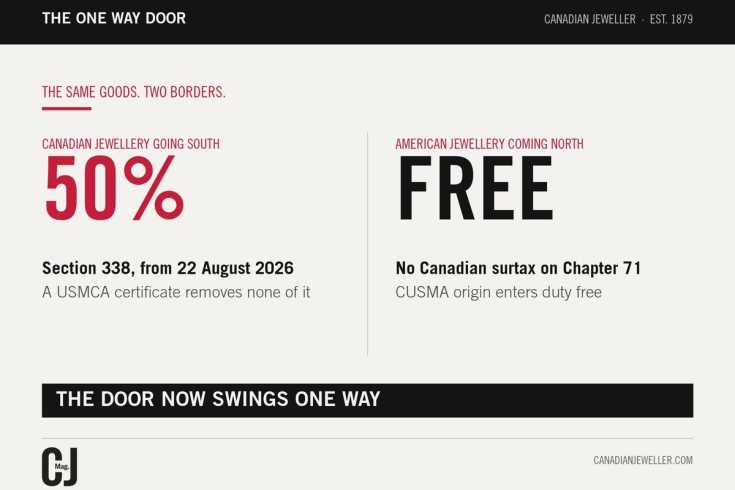
The Section 338 tariff on jewellery adds fifty per cent to seven Canadian tariff lines, and a valid USMCA certificate does not remove a single point of it. Meanwhile American jewellery and watches still enter Canada free of duty and free of surtax. The door now swings one way.
Ordinarily, trade measures reward the paperwork. A Canadian manufacturer proves origin, files the certificate, and the preference applies. That has been the working assumption in this industry since 1989 and through two renegotiations of the agreement.
Yet one measure now ignores it entirely, and that measure is the largest one in force.
What exactly does the Section 338 tariff on jewellery cover?
Section 338 of the Tariff Act of 1930 lets a president impose duties of up to fifty per cent on the goods of a country found to discriminate against American commerce. In fact, it sat unused for ninety six years. Then three proclamations signed on 20 July 2026 turned it on against Canada.
The duty is fifty per cent ad valorem, charged on top of the ordinary rate rather than instead of it. It attaches on entry for consumption or withdrawal from warehouse, so the shipment date is irrelevant. In other words, goods that crossed the border before the clock started and cleared afterwards still paid.
The clock started at 12:01 a.m. eastern time on 22 August 2026. The original date was 19 August. However, a proclamation signed on 18 August moved it three days on the strength of a Canadian commitment to negotiate. That suspension lapsed on the morning of the twenty second and has not been renewed.
Three headings carry the duty, and the naming misleads. Heading 9903.03.12 covers alcoholic beverages and 9903.03.13 covers dairy. Heading 9903.03.14 is labelled motor vehicles, yet its list runs to 513 subheadings across 57 chapters of the tariff schedule. The jewellery lines sit there, alongside cement, plywood, hockey sticks and swimming pools.
Amendments on 15 September then added 122 subheadings and removed ten. As a result, the covered total is now 666.
Why does a USMCA certificate not stop the Section 338 tariff on jewellery?
Because the drafters wrote it that way, and they wrote it unusually plainly.
Every tariff heading in the American schedule carries a General rate column and a Special column, and the Special column is where preference is granted. For headings 9903.03.12 through 9903.03.14 the Special column reads exactly what the General column reads: the duty provided in the applicable subheading, plus fifty per cent.
Furthermore, U.S. note 51 says it outright. Products eligible for special tariff treatment under general note 3(c)(i) are subject to the additional rate anyway. The note contains two exceptions and neither concerns origin. One covers certain Section 232 goods and, since 15 September, that shelter reaches only the dairy heading. Meanwhile the other covers civil aircraft.
By comparison, look at the measures that do grant relief. The IEEPA heading carried an express carve out for articles entered free of duty under general note 11. The Section 301 forced labour action states that its additional duties shall not apply to any products of Canada entered free of duty under the United States Mexico Canada Agreement. Neither formula appears anywhere in note 51. A search of the whole note for general note 11 returns nothing.
So the agreement carries full weight against every American measure except the Section 338 tariff on jewellery, which is also the biggest one.
Which Canadian jewellery lines are hit, and which are not?
Seven subheadings in Chapter 71 carry the Section 338 tariff on jewellery. Notably, none of them is obscure.
| Subheading | What lands there | Ordinary rate |
|---|---|---|
| 7113.19.50 | Gold and platinum jewellery, the general basket | 5.5% |
| 7113.19.29 | Gold necklaces and neck chains, other | 5.5% |
| 7113.11.50 | Silver jewellery, the general basket | 5% |
| 7117.19.90 | Base metal imitation jewellery, other | 11% |
| 7102.39.00 | Worked non industrial diamonds, unmounted | Free |
| 7106.92.10 | Semi manufactured silver, 99.5 per cent bars | Free |
| 7118.10.00 | Coin other than gold, not legal tender | Free |
What the Section 338 tariff on jewellery leaves outside
The gaps are wider than the list. For example, pearls of heading 7101 are outside. Precious and semi precious stones of 7103 and 7104 are outside. Gold in every form under 7108 is outside, as is platinum under 7110 and precious metal waste and scrap under 7112. We followed that bullion question through its earlier round of confusion last year.
All of heading 7114, goldsmiths’ and silversmiths’ wares, is outside. So is all of 7116, articles made of pearls or of precious stones. So is the whole of 7113.20, base metal clad with precious metal.
As a result, a fifty point swing now turns on classification. A piece that lands in 7113.19.50 pays. Meanwhile a closely related article that lands in 7114 or 7116 does not. Consequently this is a customs question with a margin attached, and it deserves a broker rather than an assumption.
Watches are untouched in both directions
In addition, Chapter 91 has no covered line at all. Not one clock, watch, movement, case or strap subheading appears in note 51. The covered list runs from 9031.49.90 straight to 9401.39.00, skipping chapters 91, 92 and 93 as a block.
What does Canada charge on American jewellery and watches?
Nothing at all, in either category.
Canada answered Section 338 with the United States Surtax Order (2026), which came into force on 8 September 2026 and applies surtaxes of 15, 25 and 50 per cent across roughly $27.6 billion of American imports. Its three schedules list 335 tariff items between them.
Notably, not one of those items is in Chapter 71 or Chapter 91. Sorted in order, the list steps from glass at 6809.11.00 and 7010.90.00 directly to iron and steel stoves at 7321.11.10. Jewellery, precious metal, stones and pearls are simply not there. The same jump appears between motorcycles at 8711.50.00 and furniture at 9401.39.10, where the watch chapter would sit.
Likewise, the other orders still running behave the same way. Steel and aluminium cover chapters 72, 73 and 76, while motor vehicles covers chapter 87. In short, none of them reaches this trade.
| Direction | Finished gold jewellery | Wrist watch |
|---|---|---|
| Canadian goods entering the United States | 50% if the line is covered | No Section 338 duty |
| American goods entering Canada, CUSMA origin | Free | Free |
| American goods entering Canada, not originating | 6.5% MFN | 5% MFN |
What does a Canadian maker actually pay to ship south?
Three measures stack, and yet only one of them ignores origin. Canadian wholesalers who worked through the 2025 rounds will recognise the shape of the exercise, though the arithmetic has changed.
| Component | USMCA originating | Not originating |
|---|---|---|
| Ordinary duty, 7113.19.50 | Free | 5.5% |
| Section 301, forced labour action | Exempt | 10% |
| Section 338 | 50% | 50% |
| Total | 50% | 65.5% |
The certificate is therefore still worth having. It removes 15.5 points on that example and 21 points on costume jewellery. Notably, it no longer removes the largest single component.
Where does the repair counter sit in this?
Here is the part that catches the trade shops, and the same note buries it.
Goods entered under Chapter 98 are generally free of the Section 338 duty. Four provisions are carved out of that relief, and three of them are the ones this industry uses. Subheadings 9802.00.40 and 9802.00.50 cover articles returned after repair or alteration abroad. Subheading 9802.00.60 covers metal processed abroad. Heading 9802.00.80 covers assembly abroad of American components.
Thus for the repair provisions the fifty per cent attaches to the value of the repair or alteration performed. For 9802.00.80 it attaches to the value assembled abroad, less the cost of the American content.
Put plainly, a Canadian bench doing warranty or trade work for an American retailer now sends the job back with a fifty per cent duty on the labour. Our piece on the repair counter as a profit centre assumed a border that did not price the work. That assumption has expired for cross border jobs.
What relief exists from the Section 338 tariff on jewellery?
Less than most importers expect, although one piece is better than expected.
Drawback is available
Even so, Customs and Border Protection confirmed on 11 September that the additional duties under headings 9903.03.12 to 9903.03.14 are eligible for drawback. That is unusual. Drawback was prohibited under the IEEPA orders and, similarly, remains prohibited under Section 232. Goods that enter the United States and are subsequently exported can therefore recover the fifty per cent.
One caution on sourcing. The August customs message wrote the heading range as 9903.04.12 to 9903.04.14, which does not exist. By contrast, the September message corrects it. Therefore work from the later one.
What does not exist
There is no exclusion process and no petition mechanism. Indeed, no agency was directed to build one. The list changes only when a proclamation changes it, as happened on 15 September.
There is no in transit grandfather either. The Section 301 action published in July carried one. Section 338 does not, and a search of all six proclamations for the word returns nothing.
Likewise, there is no de minimis floor. Separately, the $800 administrative exemption was suspended indefinitely for all countries and all modes by rules published on 24 June 2026. So small parcels have no shelter.
On the other hand, personal use goods in accompanied baggage are relieved. Foreign trade zone admissions must take privileged foreign status, which locks the classification and the duty at the door.
What is dead, and what is still being refunded?
Meanwhile the 35 per cent IEEPA border tariff is gone. On 20 February 2026 the Supreme Court held in Learning Resources, Inc. v. Trump that every tariff imposed under that authority since 3 February 2025 was unlawful. Customs and Border Protection is refunding, and the numbers involved are large: roughly $166 billion assessed across more than 53 million entries, processed through a purpose built tool in the trade system.
Anyone who paid it should therefore check their entries rather than wait.
One trap remains on the page. The tariff schedule still prints heading 9903.01.10 at the applicable subheading plus 35 per cent, with no note marking it terminated. Still, the rate is not being collected. Rather, the schedule has not caught up with the judgment.
How permanent is the Canadian exemption?
It is a policy choice, and the record shows that it has gone the other way before.
Between 13 March and 31 August 2025, American origin gold bullion, semi manufactured gold, platinum, precious metal scrap, pearls, gemstones, finished jewellery in silver, gold, platinum and clad, findings and wrist watches all carried a Canadian surtax of 25 per cent. Silver, palladium and most finished jewellery came in on 4 March under the first order. Gold, platinum, scrap, stones, pearls and watches followed nine days later under a schedule headed aluminum and other goods.
Then all of it came off on 1 September 2025, when the first order was repealed and the non metal goods were stripped out of the second. None of it returned on 8 September 2026.
Above all, the useful reading is not that this sector has been spared. It is that this sector has been on a Canadian countermeasure list within the past eighteen months, came off, and was left off when the lists were rebuilt. The Section 338 tariff on jewellery is therefore one rung on a ladder that is live on both sides. Import bans on certain American goods take effect on 29 September, covering alcohol, dairy and one motorcycle line. Nothing in this trade is on them yet.
Subscribe for more.
Frequently asked questions
Does a USMCA certificate reduce the Section 338 tariff on jewellery?
No. The Special rate column for headings 9903.03.12 to 9903.03.14 carries the same plus fifty per cent as the General column, and U.S. note 51 states that goods eligible for special tariff treatment are subject to the additional rate. The certificate still removes the ordinary duty and the Section 301 ten per cent, so it remains worth filing.
Are watches subject to the Section 338 tariff?
No. Chapter 91 has no covered subheading in U.S. note 51 at all. The covered list skips chapters 91, 92 and 93 entirely. Canada’s countermeasures do not reach Chapter 91 either, so watches move in both directions without either measure applying.
Can a Canadian retailer still import American jewellery without a surtax?
Yes. Since no tariff item in Chapter 71 or Chapter 91 appears in any Canadian surtax order in force, nothing is added at the border. Goods qualifying as CUSMA originating enter free of duty, so the border cost is sales tax only. Goods that do not qualify pay the most favoured nation rate, which runs between five and 8.5 per cent on finished jewellery and five per cent on most watches.
When did the Section 338 duty take effect?
At 12:01 a.m. eastern time on 22 August 2026. The proclamations originally set 19 August. A proclamation signed on 18 August moved the date three days, and that suspension lapsed on 22 August without renewal. The duty applies on entry for consumption or withdrawal from warehouse, not on the date of shipment.
Is the fifty per cent recoverable in any circumstance?
Duty drawback is available on these additional duties, which is not the case under Section 232 or the former IEEPA orders. Goods entered and later exported can recover. Chapter 98 entries are generally relieved, except for the repair, alteration, metal processing and assembly provisions, where the duty attaches to the value of the work performed abroad.
Sources: Proclamation 11048, Federal Register · Proclamation 11056, effective date · Proclamation 11065, scope modification · Harmonized Tariff Schedule, Chapter 99, U.S. note 51 · Section 301 forced labour action · Court ordered IEEPA refunds · Indefinite suspension of the de minimis exemption · United States Surtax Order (2026) · Customs Notice 26-23 · Surtax Order (Steel and Aluminum 2025), as made · SOR/2025-181, repeal and amendment · Customs Tariff 2026, Chapter 71
This article is general information about tariff measures and is not legal, customs or tax advice. Classification decides liability, rates change frequently, and the lists have already been amended twice. Confirm your own tariff lines with a licensed customs broker before acting.

Author: Canadian Jeweller Editorial Team
The editorial team of Canadian Jeweller Magazine, Canada’s jewellery industry publication since 1879. We report on retail strategy, diamonds and gemstones, watches, precious metals, technology, and the business of jewellery across Canada. Editorial inquiries: editor@canadianjeweller.com.


